Doon Law Mentor Get Free eBook →
Official Notification Awaited · Updated 9 October 2026

Jammu & Kashmir Judiciary Exam 2026-27: Eligibility, Syllabus, Pattern, PYQs & Preparation

Understand JKPSC Civil Judge eligibility, syllabus, pattern and previous-year papers here. Then use the free eBook to organise your Prelims, Mains and Interview preparation, with notification alerts.

FREE J&K JUDICIARY RESOURCE

Get the Free J&K Judiciary 2026-27 eBook + Notification Alert

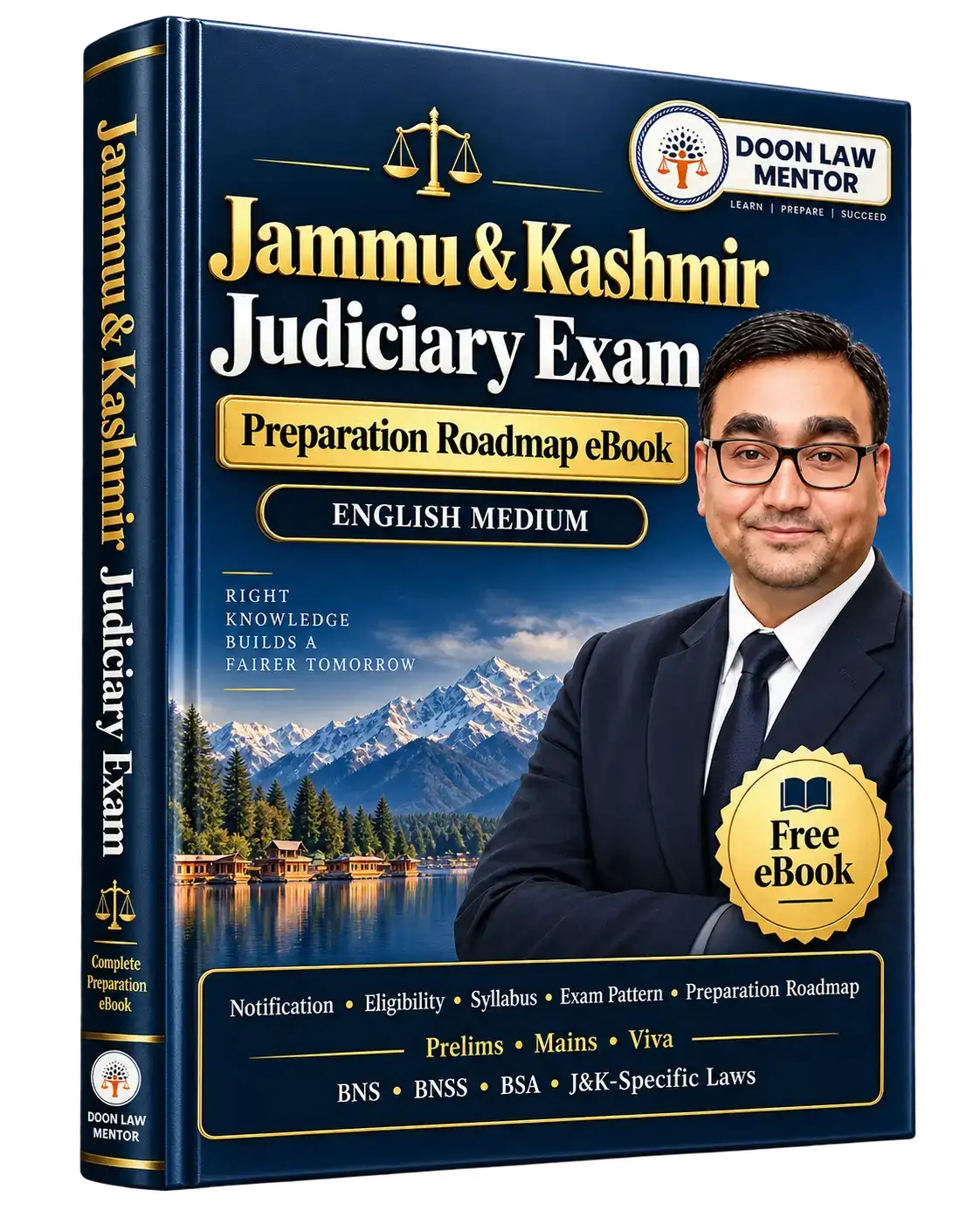
J&K Judiciary 2026-27 Preparation eBook by Doon Law Mentor

Free eBook · Delivered by Email Within Minutes

Get Your Free J&K Judiciary eBook →

Send My Free eBook

🔒 Free eBook · Delivered by Email Within Minutes

14+ YearsLaw-Teaching Experience
10,000+Law Students Mentored
Prelims → VivaComplete Judiciary Focus
Doordarshan TVFeatured & Recognised

Latest Update on Jammu & Kashmir Civil Judge 2026-27 Notification

Fresh recruitment notification awaited. As of October 2026, no new Civil Judge (Junior Division) recruitment advertisement for the next cycle was identified in the available JKPSC records. Vacancy numbers, application dates, eligibility conditions and any syllabus changes will be updated once the next official advertisement is issued. Meanwhile, continue Bare Act study, BNS–BNSS–BSA preparation, J&K-specific laws, timed MCQ practice and Mains answer writing.
Official records reviewed: 9 October 2026Check Official JKPSC Notifications ↗

For continuing state-specific current affairs study, see Current affairs and GK.

Jammu & Kashmir Civil Judge Exam 2026-27 Important Dates

Official NotificationAwaited
Application & Exam ScheduleWill be updated after the official JKPSC notification

Recruitment-specific dates will be updated only after JKPSC issues the applicable notification. Until then, the earlier recruitment calendar should not be treated as a schedule for 2026–27.

Jammu & Kashmir Judiciary Exam 2026-27: Quick Overview

ParticularDetails
Exam NameJammu & Kashmir Civil Judge Exam 2026-27
Popular NameJ&K Judiciary / JKPSC Civil Judge / JK CJ
Conducting BodyJammu and Kashmir Public Service Commission
Post NameCivil Judge Junior Division in Subordinate Judiciary
No. of PostsTo be Notified
Selection ProcessPreliminary Examination, Main Written Examination and Interview
Educational QualificationLL.B. or other recognised equivalent legal qualification
Age Limit18–35 years
Special Scoring AreasJ&K Specific Law, Rules and Regulations
Official NotificationAwaited — this page will be updated after JKPSC releases the notification
Get Notification Alert + Free eBook →

You will also receive important JKPSC Civil Judge updates by email.

For the Civil Judge's responsibilities and career profile, see Salary and job profile.

Eligibility

Who Can Apply for Jammu & Kashmir Judiciary 2026-27?

Before beginning your preparation, check the basic eligibility conditions carefully. The domicile / residence requirement is particularly important for J&K Civil Judge recruitment.

Mandatory Eligibility Requirement

Domicile / Residence Requirement

The candidate should be a Domicile of the Union Territory of Jammu & Kashmir or a resident of the Union Territory of Ladakh.

The candidate must possess a valid certificate issued by the Competent Authority in the prescribed format as on the last date fixed for submission of the online application form.

Very Important: This is a mandatory territorial eligibility condition. A candidate who is neither a domicile of the Union Territory of Jammu & Kashmir nor a resident of the Union Territory of Ladakh does not satisfy this requirement.

Educational Qualification

A candidate should possess either:

  1. A Bachelor’s Degree in Law from a University established by law; or
  2. Be a Barrister of England or Northern Ireland, or a member of the Faculty of Advocates in Scotland, or possess any other equivalent law degree recognised by the Government of India.
Practice requirement — important transitional position: Under the Supreme Court’s August 2026 transitional framework, law graduates remain eligible for Civil Judge recruitment notifications issued up to 31 March 2027, notwithstanding the earlier 3-year practice requirement, subject to the post-selection training and clerkship framework directed by the Court.

Age Limit

18–35 years, subject to the relevant cut-off date and category-wise relaxation provisions prescribed in the applicable JKPSC recruitment notification.

Keep These Documents Ready

  • Date-of-birth / age proof
  • LL.B. degree and academic records
  • Identity proof
  • J&K Domicile Certificate or applicable Ladakh Residence Certificate
  • Category / reservation certificate, where applicable
  • Any other certificate prescribed by JKPSC in the recruitment notification
Eligibility Check Before Applying: Educational qualification, age and the prescribed domicile / residence condition must all be satisfied independently. Possessing an LL.B. degree by itself does not satisfy the territorial eligibility requirement.

For official criteria and application documents, consult Eligibility and domicile.

Jammu & Kashmir Judiciary 2026-27 Selection Process

The 2026-27 selection process is expected to follow the prevailing JKPSC Civil Judge structure unless changed by the fresh notification.

1Preliminary Examination

Objective screening through Paper A and Paper B, 225 marks each.

2Main Examination

Descriptive examination with compulsory papers and 3 optional papers.

3Viva-Voce

140 marks under the prevailing scheme; tests knowledge, personality, aptitude and suitability.

4Medical Examination / Fitness

Post-selection requirement.

Jammu & Kashmir Judiciary 2026-27 Prelims Exam Pattern

The prevailing JKPSC Civil Judge Preliminary Examination consists of two objective papers.

Paper A225 Marks

General Knowledge, Constitution, BNS, BNSS, BSA and Limitation

100 Questions2 Hours
Paper B225 Marks

GFR, J&K Service Regulations, Court Rules and Civil Laws

100 Questions2 Hours
Total Prelims: 450 Marks · 2 Objective PapersNegative marking: ¼ of the marks per incorrect answer

Paper-wise Marking Scheme

Paper Questions Marks Duration Negative Marking
Paper A 100 225 Marks 2 Hours ¼ of question marks — 0.5625 mark per wrong answer
Paper B 100 225 Marks 2 Hours ¼ of question marks — 0.5625 mark per wrong answer
Total 200 450 Marks 4 Hours Applies to each incorrect answer

Pattern note: The 100-question-per-paper format reflects the prevailing 2025 Civil Judge Prelims pattern. Negative marking is one-fourth of the marks assigned to an incorrect answer under the applicable JKPSC Conduct of Examination framework. The fresh recruitment notification will prevail if JKPSC changes the scheme.

Why Prelims is Very Important

Prelims is the first major filter. It rewards statutory recall, wide syllabus coverage, time management and accuracy. The prevailing JKPSC framework also provides negative marking for incorrect answers, so preparation must include controlled attempts and elimination technique.

DLM Expert Insight: Prelims is not only a knowledge test. Your revision cycle, accuracy and ability to move between general law and J&K-specific rules can decide qualification.

Not sure how to turn the Civil Judge syllabus into a study plan?

Get the free J&K Judiciary 2026–27 eBook with a structured roadmap for Prelims, Mains and Interview.

Free eBook · Delivered by Email Within Minutes
Get My Free Study Plan
Detailed Syllabus

JKPSC Civil Judge Syllabus 2026–27 — Prelims & Mains

The JKPSC Civil Judge syllabus covers two Preliminary Examination papers, compulsory and optional Mains papers and Viva-Voce. Explore the detailed subject-wise J&K Judiciary syllabus below for preparation for the upcoming recruitment cycle.

Three Stages of JKPSC Civil Judge Preparation

Stage 1Preliminary Examination

Paper A + Paper B · 450 marks

Stage 2Main Written Examination

Compulsory and optional papers

Stage 3Interview / Viva-Voce

Legal knowledge, judgment and suitability

Important Current-Law Update — J&K Tenancy Law

The presently available official JKPSC Civil Judge syllabus still refers to the Jammu and Kashmir Residential and Commercial Tenancy Act, 2012. However, the 2012 Act has been repealed by Section 47 of the Jammu and Kashmir Tenancy Act, 2025, and the 2025 Act came into force on 15 February 2026. Therefore, for the upcoming recruitment cycle, aspirants should prepare the Jammu and Kashmir Tenancy Act, 2025 as the current tenancy law, while also checking the fresh JKPSC notification/syllabus for the Commission's final prescribed wording.

JKPSC Civil Judge Prelims Paper A Syllabus

Paper A combines General Knowledge, Indian Constitutional Law, the three new criminal laws and the Limitation Act, 1963.

Paper A Preparation Focus: Build constitutional law and the three new criminal laws around Bare Act accuracy, conceptual clarity, PYQs and repeated objective revision rather than relying only on explanatory notes.
Paper A Preparation Guide Need a complete strategy for J&K Civil Judge Paper A?

Go beyond the syllabus with a subject-wise preparation plan for General Knowledge, Constitutional Law, BNS, BNSS, BSA and the Limitation Act, including Bare Act reading, PYQs, revision cycles, mock-test planning and negative-marking strategy.

For a focused revision plan, see Paper A strategy.

Detailed Topic Coverage for JKPSC Civil Judge Prelims Paper A

Use the following topic-wise coverage as a preparation checklist while studying Paper A.

Indian Constitutional Law — Important Topics for J&K Judiciary
  • Preamble and basic constitutional philosophy
  • Citizenship
  • Fundamental Rights
  • Directive Principles of State Policy
  • Fundamental Duties
  • Doctrine of judicial review
  • Writ jurisdiction and constitutional remedies
  • Union and State Executive
  • Parliament and State Legislatures
  • Supreme Court and High Courts
  • Centre-State legislative and administrative relations
  • Distribution of legislative powers
  • Emergency provisions
  • Constitutional amendment and Basic Structure doctrine
  • Constitutional and statutory bodies frequently tested in competitive examinations
  • Important constitutional doctrines and landmark Supreme Court principles
BNSS Topics for JKPSC Civil Judge Preparation
  • Constitution and powers of criminal courts
  • Arrest and safeguards relating to arrested persons
  • Processes to compel appearance and production of things
  • Information to police and investigation
  • Search, seizure and investigation-related powers
  • Jurisdiction of criminal courts in inquiries and trials
  • Initiation of proceedings before Magistrates
  • Complaints to Magistrates
  • Charge and joinder of charges
  • Trial before different criminal courts
  • Summary trials
  • Bail and bonds
  • Maintenance of public order and tranquility
  • Evidence during inquiries and trials
  • Judgment and sentencing procedure
  • Appeal, reference and revision
  • Limitation for taking cognizance
  • Electronic and technology-enabled procedural changes under BNSS
  • Major changes from the repealed CrPC frequently relevant for Prelims
BSA Topics for JKPSC Civil Judge Preparation
  • Definitions and fundamental concepts of evidence
  • Relevancy of facts
  • Facts forming part of the same transaction
  • Motive, preparation and conduct
  • Admissions
  • Confessions
  • Statements by persons who cannot be called as witnesses
  • Dying declarations
  • Judgments of courts when relevant
  • Expert opinion and opinion evidence
  • Character when relevant
  • Facts which need not be proved
  • Oral evidence
  • Documentary evidence
  • Electronic and digital records
  • Public and private documents
  • Presumptions relating to documents and electronic records
  • Burden of proof
  • Estoppel
  • Competency and examination of witnesses
  • Major changes introduced by BSA over the Indian Evidence Act
BNS Topics for JKPSC Civil Judge Preparation
  • Definitions and general explanations
  • Punishments
  • General Exceptions
  • Right of private defence
  • Abetment
  • Criminal conspiracy
  • Attempt
  • Offences against women and children
  • Offences affecting the human body
  • Culpable homicide and murder
  • Hurt and grievous hurt
  • Wrongful restraint and wrongful confinement
  • Kidnapping and abduction
  • Offences against the State
  • Offences against public tranquility
  • Offences relating to public servants and administration of justice
  • Offences against property
  • Theft, extortion, robbery and dacoity
  • Criminal breach of trust and cheating
  • Mischief and criminal trespass
  • Forgery and document-related offences
  • Defamation
  • New offences and important structural changes introduced by BNS
Limitation Act, 1963 — Important Topics for Prelims
  • Bar of limitation
  • Extension of prescribed period in certain cases
  • Legal disability
  • Continuous running of time
  • Computation of limitation
  • Exclusion of time in legal proceedings
  • Effect of death before accrual of right to sue
  • Effect of fraud and mistake
  • Acknowledgment in writing
  • Effect of payment on account of debt or interest
  • Continuing breaches and continuing torts
  • Acquisition of easements by prescription
  • Extinguishment of right to property
  • Structure and frequently tested periods contained in the Schedule

JKPSC Civil Judge Prelims Paper B Syllabus

Paper B combines General Financial Rules, J&K Service Regulation, subordinate court material and core civil laws. It requires a separate provision-based preparation strategy.

DLM Expert Insight: Paper B can become a scoring differentiator because many candidates are comfortable with CPC and TPA but comparatively weak in service regulations, subordinate court rules, High Court circulars and J&K-specific law.
Paper B Preparation Guide Need a complete strategy for J&K Civil Judge Paper B?

Go beyond the syllabus with a structured preparation plan for GFR, J&K Civil Service Regulations, subordinate-court rules, High Court circulars, CPC, Registration, TPA and current tenancy law, including PYQs, rule-based revision, mock tests and a 30-day framework.

For subject-wise revision, see Paper B strategy.

Detailed Topic Coverage for JKPSC Civil Judge Prelims Paper B

These accordions convert the Paper B syllabus into an actionable subject-wise preparation checklist.

General Financial Rules, 2017 — Important Topics for JKPSC Civil Judge
  • General principles of financial management
  • Standards of financial propriety
  • Budget formulation and implementation
  • Government receipts
  • Government expenditure
  • Control of expenditure
  • Works
  • Procurement of goods
  • Procurement of services
  • Consultancy and other services
  • Government contracts
  • Inventory and asset management
  • Grants-in-aid and loans
  • Accounts and financial reporting
  • Audit-related responsibilities
  • Authorities, approvals, sanctions and procedural safeguards
  • Frequently tested definitions, monetary controls and exceptions
Official Government Source: General Financial Rules, 2017 — Department of Expenditure, Ministry of Finance, Government of India

The linked official compilation is updated up to 31 January 2026. Candidates should also remain alert to subsequent amendments and instructions issued by the Department of Expenditure.

J&K Service Regulation, 1956 — Chapters III–XIII, XXII & XXIII

The prescribed portion should be read chapter-wise with special attention to rules, exceptions, competent authorities and procedural requirements.

  • Chapter III: General Rules relating to service, age, health, employment, lien and allied matters
  • Chapter IV: Additions to salary and deputations
  • Chapter IV-A: Government residences and related rent provisions
  • Chapter V: Officiating Allowances — General Rules
  • Chapter VI: Officiating Allowance and its calculation
  • Chapter VII: Regulation of pay and allowances in progressive or time-scale appointments
  • Chapter VIII: Combination of appointments and salaries
  • Chapter IX: Joining time
  • Chapter X: Officers dismissed, suspended or imprisoned
  • Chapter XI: General conditions of leave
  • Chapter XII: Short leave
  • Chapter XIII: Long leave
  • Chapter XXII: Application for and grant of leave
  • Chapter XXIII: Payment of leave allowances

For Prelims, pay particular attention to definitions, conditions, exceptions, competent authorities, time limits and consequences arising from non-compliance with the rules.

For detailed statutory coverage, read Civil Service Regulations.

Subordinate Court Rules & High Court Circular Orders — What to Prepare
  • Rules governing civil and criminal subordinate courts
  • Institution and processing of judicial proceedings
  • Issue and service of processes
  • Summons, warrants and procedural court documents
  • Registers maintained by subordinate courts
  • Judicial and administrative record management
  • Inspection of court records
  • Certified copies and copying procedure
  • Preservation, transmission and consignment of records
  • Deposits, accounts and court-related administrative procedure
  • Responsibilities of judicial and ministerial court staff
  • Directions contained in important High Court Circular Orders
  • Differences between civil and criminal court procedure wherever specifically prescribed

This subject should be prepared directly from the prescribed rules and circulars because objective questions may turn on exact procedural language.

Code of Civil Procedure, 1908 — High-Yield Prelims Topics
  • Jurisdiction of civil courts
  • Res sub judice and res judicata
  • Place of suing
  • Parties to suits
  • Joinder and misjoinder
  • Pleadings
  • Plaint and written statement
  • Return and rejection of plaint
  • Set-off and counterclaim
  • Issue and service of summons
  • Appearance and non-appearance of parties
  • Ex parte proceedings
  • Discovery, inspection and admissions
  • Settlement of issues
  • Interim and interlocutory orders
  • Temporary injunctions
  • Commissions
  • Judgment, decree and order
  • Execution of decrees
  • Appeals
  • Reference, review and revision
  • Suits by or against Government
  • Special suits and miscellaneous proceedings
  • Inherent powers of the court
Registration Act, 1908 — Important Topics for JKPSC Civil Judge
  • Documents of which registration is compulsory
  • Documents of which registration is optional
  • Time for presentation of documents
  • Place of registration
  • Persons entitled to present documents
  • Appearance before registering officers
  • Enquiry before registration
  • Admission and denial of execution
  • Refusal to register
  • Appeal and application against refusal
  • Effect of registration
  • Effect of non-registration
  • Priority of registered documents
  • Powers and duties of registering officers
  • Penalties and offences under the Act
Transfer of Property Act, 1882 — Important Topics for Prelims
  • Meaning and essentials of transfer of property
  • What may and may not be transferred
  • Competency to transfer
  • Conditions restraining alienation
  • Vested and contingent interests
  • Doctrine of election
  • Transfer by ostensible owner
  • Feeding the grant by estoppel
  • Doctrine of lis pendens
  • Fraudulent transfers
  • Doctrine of part performance
  • Sale of immovable property
  • Mortgages and charges
  • Rights and liabilities of mortgagor and mortgagee
  • Redemption and foreclosure
  • Lease
  • Exchange
  • Gift
  • Actionable claims
J&K Tenancy Act, 2025 — Important Topics for 2026–27 Preparation

Because this is the current tenancy legislation for J&K, students should build a separate updated-law revision sheet around its institutional and procedural framework.

  • Object, extent and application of the Act
  • Important statutory definitions
  • Tenancy agreement and information to the Rent Authority
  • Period and renewal of tenancy
  • Restriction on sub-letting
  • Rent payable and revision of rent
  • Security deposit
  • Rights and obligations of landlords and tenants
  • Payment and deposit of rent
  • Repair and maintenance obligations
  • Essential services
  • Eviction and recovery of possession
  • Consequences after expiry of tenancy
  • Rent Authority — constitution, powers and procedure
  • Appeals from the Rent Authority
  • Rent Court and Rent Tribunal
  • Procedure, jurisdiction and execution of orders
  • Bar of civil-court jurisdiction in matters governed by the Act
  • Court fees and miscellaneous provisions
  • Schedules and prescribed statutory forms

For detailed statutory coverage, read Tenancy Act, 2025.

For detailed study of Paper B's special subjects, consult GFR 2017 and Subordinate Court Rules.

Jammu & Kashmir Judiciary 2026-27 Mains Exam Pattern

The Mains examination is descriptive. Under the prevailing scheme, candidates take 6 compulsory papers and choose 3 of the 6 optional-paper groups. Each paper carries 100 marks and is of 3 hours.

CompulsorySix compulsory papers600 marks · six papers of 100 marks
OptionalsChoose three optionals300 marks · three papers of 100 marks
TotalTotal written Mains900 marks · 3 hours per paper

Viva-Voce: 140 marks under the prevailing scheme. Read the official notification for any future change.

ParticularDetails
TypeDescriptive / Written
Compulsory Papers6 Papers
Optional PapersChoose 3 out of 6 optional-paper groups
Marks per Paper100 Marks
Duration per Paper3 Hours

Why Mains Requires a Different Strategy

Prelims tests recognition. Mains tests expression. A good answer should show the relevant provision, legal concept, application, reasoning and a clear conclusion.

1
Identify the IssueBegin with a clear introduction and correctly identify the legal issue involved.
2
State the Relevant LawMention the applicable statutory provision, rule or legal principle accurately.
3
Explain the Legal PrincipleDemonstrate conceptual clarity and support the answer with the correct legal reasoning.
4
Apply and ConcludeApply the law to the issue and finish with a concise, reasoned conclusion.

For subject-wise revision, see Mains answer writing.

JKPSC Civil Judge Mains Compulsory Papers

Paper I

English Essay · Translation from English into Urdu/Hindi and vice versa · Précis

Paper II

General Knowledge · Indian Constitutional Law

Paper III

BNSS · BSA · BNS

Paper IV

General Financial Rules · J&K Service Regulation · Rules and Orders for the Guidance of Subordinate Courts (Civil and Criminal) · High Court Circular Orders

Paper V

Code of Civil Procedure · Limitation Act · Registration Act

Paper VI

Transfer of Property Act · J&K tenancy law

How to Prepare the Compulsory Papers for Mains

Paper I — English Essay, Translation & Précis Preparation
  • Essay structure: introduction, issue development and conclusion
  • Legal and constitutional essay themes
  • Rule of law and constitutional governance
  • Access to justice and judicial reforms
  • Technology and administration of justice
  • Contemporary legal and socio-legal issues
  • Translation of ordinary and legal passages
  • Accurate legal vocabulary
  • Grammar, sentence structure and meaning preservation
  • Précis writing and identification of the central idea
  • Compression without distortion of meaning
  • Timed weekly writing practice
Papers II–VI — Legal Answer Writing Strategy

The substantive syllabus substantially overlaps with Prelims, but the examination demand changes from recognition to legal articulation and application.

  1. Identify the legal issue raised by the question.
  2. State the governing statutory provision or relevant rule accurately.
  3. Explain the legal principle in clear and precise language.
  4. Add relevant case law where it genuinely strengthens the answer.
  5. Apply the provision to the facts in problem-based questions.
  6. Distinguish related doctrines where the examiner is testing conceptual differences.
  7. Conclude directly instead of repeating the introduction.
  8. Practise writing within the actual examination time constraint.
DLM Expert Insight: Prepare overlapping Prelims–Mains subjects once at two depths: statutory accuracy for objective questions and structured legal reasoning for descriptive answers.

JKPSC Civil Judge Optional Papers

Candidates choose 3 optional-paper groups from the available options. Optional selection should be based on conceptual comfort, source availability, PYQs and the ability to write descriptive answers.

Optional Paper I

Hindu Law · Mohammedan Law

Optional Paper II

Law of Companies · Insurance Law

Optional Paper III

Principles of Equity · Law of Trusts · Specific Relief

Optional Paper IV

Indian Contract Act, 1872 · Law of Torts

Optional Paper V

Suits Valuation · Court Fees · Indian Stamp law · Excise law and Rules

Optional Paper VI

Land Revenue law · Right to Fair Compensation and Transparency in Land Acquisition, Rehabilitation and Resettlement Act, 2013

For subject-wise revision, see Optional papers.

Detailed Optional Paper Preparation Areas

Optional Paper I — Hindu Law & Mohammedan Law
  • Sources and schools of personal law
  • Marriage and matrimonial remedies
  • Divorce and judicial separation
  • Maintenance
  • Adoption
  • Guardianship
  • Hindu succession and inheritance
  • Joint Hindu family and coparcenary
  • Partition
  • Muslim marriage and dower
  • Divorce under Muslim law
  • Maintenance under Muslim personal law
  • Gift or Hiba
  • Wakf
  • Muslim inheritance and succession
Optional Paper II — Company Law & Insurance Law
  • Nature and incorporation of companies
  • Separate legal personality
  • Memorandum and Articles of Association
  • Doctrine of ultra vires
  • Share capital and membership
  • Directors and their duties
  • Company meetings and resolutions
  • Oppression and mismanagement
  • Corporate liability and remedies
  • Fundamental principles of insurance
  • Insurable interest
  • Utmost good faith
  • Indemnity
  • Subrogation and contribution
  • Life, fire and marine insurance principles
  • Insurance claims and liability
Optional Paper III — Equity, Trusts & Specific Relief
  • Nature and origin of equity
  • Important equitable maxims
  • Equitable rights and remedies
  • Creation and classification of trusts
  • Duties and liabilities of trustees
  • Rights and liabilities of beneficiaries
  • Breach of trust
  • Extinction of trusts
  • Recovery of possession
  • Specific performance of contracts
  • Contracts not specifically enforceable
  • Rectification of instruments
  • Rescission
  • Cancellation of instruments
  • Declaratory relief
  • Temporary, perpetual and mandatory injunctions
Optional Paper IV — Contract & Torts
  • Offer and acceptance
  • Consideration
  • Capacity to contract
  • Free consent
  • Void and voidable agreements
  • Contingent contracts
  • Performance and discharge
  • Breach and damages
  • Quasi-contractual obligations
  • Indemnity and guarantee
  • Bailment and pledge
  • Agency
  • General principles of tortious liability
  • Negligence
  • Nuisance
  • Defamation
  • Vicarious liability
  • Strict and absolute liability
  • Remoteness of damage
  • General defences and remedies
Optional Paper V — Suits Valuation, Court Fees, Stamp & Excise
  • Principles governing valuation of suits
  • Relationship between jurisdictional value and court-fee valuation
  • Computation and payment of court fees
  • Deficient court fee and consequences
  • Refund of court fees where permissible
  • Chargeability of instruments to stamp duty
  • Proper stamping of instruments
  • Adjudication regarding stamp duty
  • Impounding of insufficiently stamped instruments
  • Effect of instruments not duly stamped
  • Relevant J&K excise authorities and regulatory structure
  • Licensing and permissions under applicable excise law
  • Excise duties, offences, penalties and procedural provisions
Optional Paper VI — Land Revenue & RFCTLARR Act, 2013
  • Revenue authorities and their powers
  • Revenue records and record-of-rights
  • Mutation and entries in revenue records
  • Assessment and collection of land revenue
  • Partition and revenue proceedings
  • Appeals, review and revision under revenue law
  • Important definitions under the RFCTLARR Act, 2013
  • Social Impact Assessment
  • Preliminary notification and acquisition procedure
  • Determination of compensation
  • Award by the Collector
  • Rehabilitation and Resettlement
  • Special safeguards and statutory entitlements
  • Land Acquisition, Rehabilitation and Resettlement Authority
  • Reference, appeal and enforcement-related provisions
Optional Selection Strategy: Do not select an optional merely because its syllabus looks short. Compare your existing subject command, Bare Act comfort, PYQ demand, available preparation material and answer-writing confidence.

Mains Answer Writing: Start Before the Prelims Result

The J&K Civil Judge Mains examination tests legal explanation and application, not only memory. Start descriptive work while preparing for the objective papers.

1. Issue

Identify the question and relevant facts precisely.

2. Law

State the current statute, rule and legal principle accurately.

3. Application

Explain how the provision applies to the given facts.

4. Conclusion

Finish with a concise reasoned answer and revise presentation under timed conditions.

For worked examples and a practice framework, continue with the Mains Answer Writing guide.

High-Priority Criminal Laws

BNS · BNSS · BSA for J&K Judiciary

Prepare the three new criminal laws directly from the Bare Acts, with provision-level accuracy for Prelims and structured application for Mains.

Official statutory texts: Act names above link directly to India Code, Government of India.

Preparation Focus: Bare Act accuracy for Prelims + issue, provision, application and reasoning for Mains.
J&K-Specific Preparation

J&K-Specific Laws and Court Rules for Judiciary

J&K-specific statutory and administrative material deserves a separate revision track. These areas should not be mixed casually with the general civil-law syllabus.

Preparation Method: For every J&K-specific subject, prepare the exact applicable chapters or rules, important definitions, authorities, powers, procedures, timelines and frequently testable statutory language. These subjects should have their own short revision notes and MCQ cycle.

General Financial Rules, 2017

Study definitions, financial authority, procurement and accountability rules as prescribed in Paper B. Further reading: GFR 2017 guide.

J&K Service Regulations, 1956

Follow the prescribed chapters, powers, exceptions and service conditions; make chapter-wise rule sheets. Further reading: Service Regulations guide.

Subordinate Court Rules & Circulars

Separate civil and criminal court guidance, High Court circular orders and procedural duties. Further reading: Court Rules guide.

J&K Tenancy Act, 2025

Study the current Act and the change from the syllabus-referenced 2012 law; verify the next official syllabus. Further reading: Tenancy Act guide.

English Essay, Translation and Précis for JK Judiciary Mains

Paper I is highly improvable if you practise it every week instead of postponing it to the final month.

English Essay

Legal and constitutional themes · Rule of law · Access to justice · Judicial reforms · Current socio-legal issues

Translation

English ↔ Hindi / Urdu as permitted · Legal vocabulary · Accuracy · Grammar · Sentence structure · Timed practice

Précis

Central idea · Concise expression · Logical flow · Clear language · Word-limit discipline

DLM Expert Insight: Paper I can improve your Mains score because performance is driven by practice, not merely reading.
Official Previous Year Papers

J&K Judiciary Previous Year Question Papers (PYQs) for 2026-27 Preparation

Access JKPSC Civil Judge Prelims and Mains question papers year-wise through official JKPSC PDF links.

Official Source: Every question-paper link below opens the PDF hosted on the Jammu & Kashmir Public Service Commission website.
2025 Previous Year Papers
YearStageQuestion PaperOfficial JKPSC PDF
2025 Prelims Paper I View Official PDF
2025 Prelims Paper II View Official PDF
2025 Mains Compulsory & Optional Papers View Official PDF
2023 Previous Year Papers
YearStageQuestion PaperOfficial JKPSC PDF
2023 Prelims Paper I View Official PDF
2023 Prelims Paper II View Official PDF
2023 Mains Compulsory & Optional Papers View Official PDF
2018 Previous Year Papers
YearStageQuestion PaperOfficial JKPSC PDF
2018 Prelims Paper I View Official PDF
2018 Prelims Paper II View Official PDF
2018 Mains Compulsory & Optional Papers View Official PDF
How to use PYQs: Attempt each paper under exam conditions, identify recurring provisions and J&K-specific areas, and convert mistakes into your next revision cycle.

J&K Judiciary Preparation Strategy — What to Study and in What Order

Build the preparation plan around JKPSC's paper-wise syllabus rather than unrelated law notes. Keep the J&K-specific subjects visible throughout revision.

01

Map the Official Syllabus

Checklist for Paper A, Paper B and Mains.

02

Master BNS, BNSS and BSA

Study the current BNS, BNSS and BSA.

03

Give J&K Laws Their Own Track

Keep a dedicated J&K laws revision track.

04

Build a Civil-Law Foundation

Master CPC, Limitation, Registration and TPA.

05

Analyse Official PYQs

Use official PYQs to prioritise revision.

06

Start Descriptive Writing Early

Practise structured Mains answers early.

07

Choose Optional Papers Deliberately

Compare all six optional subject groups.

08

Revise, Test and Track Weaknesses

Track mock errors and weak areas.

Detailed preparation steps
1. Map the Official Syllabus

Create separate checklists for Paper A, Paper B, compulsory Mains papers and optional papers. Keep marks, time and question formats visible while planning.

2. Master BNS, BNSS and BSA

Read the current Bare Acts, connect related provisions and practise accurate section-based MCQs. Compare older-code PYQs carefully with the new laws.

3. Give J&K Laws Their Own Track

Revise GFR, Civil Service Regulations, subordinate-court rules, High Court circulars and tenancy law as distinct subjects, not as an appendix to CPC.

4. Build a Civil-Law Foundation

Study CPC, Limitation, Registration and Transfer of Property through definitions, procedural rules, exceptions and short problem-based examples.

5. Analyse Official PYQs

Solve previous papers under timed conditions; classify errors by subject, statute, recall and interpretation rather than just calculating scores.

6. Start Descriptive Writing Early

Write structured answers with the issue, applicable legal provisions, legal reasoning, factual application and a concise conclusion; practise English composition as prescribed.

7. Choose Optional Papers Deliberately

Compare the six prescribed optional groups using background knowledge, genuine syllabus coverage, reliable sources and answer-writing comfort.

8. Revise, Test and Track Weaknesses

Maintain an error log, revisit difficult statutory provisions and combine timed mock tests with Mains answer practice; adjust the plan when JKPSC publishes fresh instructions.

For the detailed paper-by-paper approach, consult Paper A strategy, Paper B strategy and Mains answer writing.

Build a Practical J&K Judiciary Study Sequence

Use the prescribed examination syllabus as your study checklist, and integrate Prelims revision with regular Mains practice.

01

Foundation

Map the scheme and make a Bare Act timetable.

02

Concepts + J&K Laws

Combine central laws with J&K-specific rules.

03

PYQs + Active Recall

Use PYQs, short tests and active recall.

04

Timed Practice + Writing

Practise timed Prelims and Mains answers.

05

Revision + Exam Readiness

Revise weaknesses and check JKPSC updates.

What each study stage includes
1. Foundation

Read the official exam scheme. Map Paper A, Paper B and Mains options, then build a weekly Bare Act timetable.

2. Concepts + J&K Laws

Cover the central statutes and maintain a separate revision file for GFR, Service Regulations, Court Rules, Circular Orders and the current tenancy law.

3. PYQs + Active Recall

Classify previous-year questions, test short topic blocks and revisit statutory definitions, exceptions and procedural steps.

4. Timed Practice + Writing

Combine objective timed papers with descriptive answers, English paper practice and weekly performance review.

5. Revision + Exam Readiness

Use an error log, concise revision sheets and full-length practice. Recheck official JKPSC notifications before finalising the schedule.

For paper-wise planning, see Paper A strategy and Paper B strategy.

Practice and Revision Strategy

Start J&K Judiciary 2026-27 Test Practice Early

Reading gives knowledge. Testing reveals selection readiness.

Preparation Level

See how much of your present study can actually be converted into exam-ready answers.

Accuracy

Measure how consistently you can answer correctly under exam conditions.

Speed

Learn when to solve, skip and return without losing valuable examination time.

Weak Areas

Identify subjects and provisions that need deeper conceptual or Bare Act revision.

Revision Gaps

Convert every test into a targeted revision list instead of revising everything again.

Exam Temperament

Build decision-making discipline for pressure, negative marking and time-bound attempts.

Get Free eBook

Use timed practice, error analysis and Bare Act revision to strengthen weak areas after understanding the syllabus.

JKPSC Civil Judge Viva-Voce — 140 Marks

The Viva-Voce evaluates legal clarity, personality, judgment, communication and overall suitability for judicial office.

ParticularDetails
Viva-Voce Marks 140 Marks under the prevailing scheme
Purpose Assessment of intelligence, general knowledge, personality, aptitude and suitability
Preparation Focus Legal clarity, judicial temperament, current legal developments, J&K awareness and communication

For official criteria and application documents, consult Interview preparation.

Detailed JKPSC Civil Judge Viva Preparation Areas

Personal Profile, Judicial Motivation & Personality Questions
  • Introduce yourself in a structured and professional manner
  • Why do you want to join the Judiciary?
  • Why Civil Judge rather than litigation or another legal career?
  • Academic background and law-school subjects
  • Employment or litigation experience, where applicable
  • Strengths and areas requiring improvement
  • Hobbies and interests
  • Home district and local issues
  • Role and responsibilities of a Civil Judge
  • Qualities expected from a judicial officer
  • Impartiality, patience and courtroom temperament
  • Handling pressure, workload and difficult litigants
Legal, Constitutional & Practical Court Questions
  • Constitutional values and judicial independence
  • Rule of law and access to justice
  • Natural justice
  • Judicial ethics
  • Recusal and conflict of interest
  • BNS, BNSS and BSA developments
  • CPC and basic civil-court procedure
  • Evidence and burden of proof
  • Bail and procedural safeguards
  • Interim relief and injunctions
  • Execution of decrees
  • Problem-based factual situations
  • Courtroom management scenarios
  • Balancing technical procedure with substantive justice
Jammu & Kashmir, Current Legal Issues & Judicial Awareness
  • Basic administrative and institutional structure of the Union Territory
  • Important J&K-specific laws appearing in the examination syllabus
  • J&K High Court and subordinate judiciary structure
  • Current legal developments affecting civil and criminal justice
  • Important recent Supreme Court and High Court judgments
  • Technology and digitisation of courts
  • Artificial intelligence and the justice system
  • Access to justice and legal aid
  • Case pendency and judicial delay
  • Mediation and Alternative Dispute Resolution
  • Gender justice and protection of vulnerable groups
  • Environmental and socio-legal issues relevant to the region
  • Balanced responses to contemporary legal controversies
DLM Expert Insight: A future Civil Judge should demonstrate legal clarity, constitutional commitment, fairness, patience, practical judgment and the ability to remain balanced under pressure.
Further Reading

J&K Judiciary Preparation Video

Watch the available strategy session, then follow the relevant paper-wise guides.

Preparation Strategy

Jammu & Kashmir Judiciary Complete Preparation Strategy

Understand how to approach JKPSC Civil Judge preparation and organise your study for the examination.

For further preparation, explore Paper A strategy, Paper B strategy and Mains answer writing.

Ashish Jain Sir, Founder of Doon Law Mentor
Meet Your Mentor

Learn from Ashish Jain Sir — Founder, Doon Law Mentor

Known for simplifying complex Bare Acts, new criminal laws and examination concepts for Prelims, Mains and Interview preparation.

14+ Years of Law-Teaching Experience
UGC-NET & JRF in Law
Mentor of Change, Atal Innovation Mission, NITI Aayog
Former Assistant Professor of Law — ICFAI University & UPES
LL.M., Faculty of Law, University of Delhi
LL.B., Campus Law Centre, University of Delhi
Teaching philosophy: simplify complex Bare Acts, connect provisions with concepts and exam demand, and build legal clarity through structured revision and practice.
Learn with us on YouTube

Watch Ashish Jain Sir’s teaching and exam-strategy guidance

Use the long-form sessions on our two channels for Bare Act clarity, current legal updates and Judiciary/APO preparation.

BNS vs IPC — Bare Act StrategyActual teaching sample by Ashish Jain Sir · Doon Law Mentor

Strategy Discussion and Media Recognition

Doon Law Mentor’s Founder Ashish Jain Sir has been featured on Doordarshan for legal-exam strategy and preparation guidance.

Recognised Media & Legal-Education Presence

Doon Law Mentor and Ashish Jain Sir have been featured across public-media, innovation and legal-education platforms.

Mentor of Change, Atal Innovation Mission
Fox Story India
Borok Times
Careers360
Results & Student Experiences

Trusted by Judiciary, APO & Law Aspirants

Doon Law Mentor students have used our courses, Bare Act-focused teaching, test practice, answer-writing support and personalised mentoring across Judiciary, APO and other competitive law examinations.

4.9 / 5Google Business Rating63 Reviews
50+Judiciary & APO SelectionsDLM Results
10,000+Law Students MentoredDLM Community
Rank 2 Topper Discussion

Hear Directly from Srishti Baniyal

Hear directly from Srishti Baniyal about her Judiciary preparation journey, interview strategy and experience with Doon Law Mentor.

  • Judiciary preparation journey
  • Interview strategy and readiness
  • Structured mentoring experience
  • Insights for Judiciary aspirants

Selected Candidates & Top Rankers

Published DLM success stories from Judiciary and APO examinations.

Srishti Baniyal Uttarakhand Judiciary Rank 2 UKPCSJ · Rank 2

Srishti Baniyal

Uttarakhand Judicial Services

“The comprehensive lectures, study material, expert guidance and mock-interview preparation helped me strengthen my Judiciary preparation.”

Kajal Rani Judiciary Rank 11 Judiciary · Rank 11

Kajal Rani

Judicial Services Selection

“The personalised guidance and detailed subject coverage helped me prepare with greater confidence.”

Gourav Agarwal Uttarakhand APO Rank 27 UKAPO · Rank 27

Gourav Agarwal

Selected as Assistant Prosecution Officer

“Ashish Jain Sir’s guidance, preparation support and mentoring gave me greater direction and confidence for the APO examination.”

Candidate Conversation

Hear Directly from Selected Candidates

Students discuss preparation strategy, Bare Act focus, mock practice, interview readiness and the role of structured mentoring during their examination journey.

  • Bare Act-focused preparation
  • PYQ and mock-test practice
  • Exam strategy and revision planning
  • Interview and personality guidance

What Students Say About the DLM Learning Experience

Published student feedback also consistently highlights concept clarity, detailed teaching, practical examples, doubt support and the DLM mobile learning experience.

SB

Simran Bhaskar

Judiciary Aspirant

“The Judiciary sessions are detailed and full of practical examples. The case-law-based study material and mentorship have been very helpful for my preparation.”

DLM Student Review
IM

Ishan Mathur

Judiciary Student

“My experience with Doon Law Mentor has been very knowledgeable. The classes have improved my conceptual clarity, and I receive consistent support whenever I need help with doubts.”

DLM Academy Review
Transparency: Transparency Note: The student results and reviews above reflect Doon Law Mentor’s broader Judiciary and APO mentoring experience. The named selections shown are from their respective examinations and are not presented as J&K Civil Judge selections.

Why Choose Doon Law Mentor for Jammu & Kashmir Judiciary?

Choosing the right guidance can save months of confusion. The focus is on updated, structured and exam-oriented preparation.

Judiciary-Focused

Tenancy Act 2025 — Current-Law Tracking

Separate J&K Revision Track

PYQ-Led Priority

Prelims + Mains Together

Testing + Revision

National Online Law Mentoring

14+ Years of Legal Teaching

Academic Resources Together

More about our preparation approach
1. Judiciary-Focused

Preparation aligned to Prelims, Mains and Viva demand.

2. Tenancy Act 2025 — Current-Law Tracking

We flag the official syllabus’s older 2012 tenancy reference and prepare the Jammu and Kashmir Tenancy Act, 2025 as the current law, subject to the fresh JKPSC syllabus.

3. Separate J K Revision Track

Dedicated revision for J&K Civil Service Regulations, 1956, GFR 2017, Subordinate Court Rules & High Court Circulars, and the Tenancy Act, 2025.

4. PYQ-Led Priority

Use real exam demand to decide what deserves deeper revision.

5. Prelims + Mains Together

Avoid beginning descriptive preparation only after Prelims.

6. Testing + Revision

Convert learning into recall through tests, error analysis and revision loops.

7. National Online Law Mentoring

Preparation resources and study guidance designed for aspiring judicial officers across India.

8. 14+ Years of Legal Teaching

Legal concepts explained through structured Bare Act study, examples and exam-oriented revision.

9. Academic Resources Together

Use the syllabus, official PYQs, contextual subject guides and one free preparation eBook in a coherent study sequence.

Our Preparation Philosophy: Legal education should be simple, structured and result-oriented. Aspirants should not feel lost between Bare Acts, old notes, random PDFs and scattered videos.

Common J&K Judiciary Preparation Mistakes to Avoid

01

Ignoring J&K-specific laws

02

Using superseded criminal-law notes

03

Delaying Mains answer writing

04

Taking mocks without analysis

05

Neglecting negative marking

06

Mixing Paper A and Paper B

07

Overlooking compulsory English

08

Choosing optionals without comparison

09

Memorising without application

10

Studying without a revision cycle

How to avoid these mistakes
1. Ignoring J&K-specific laws

GFR, service regulations, court rules and circular orders demand independent, provision-based revision.

2. Using superseded criminal-law notes

Check every topic against BNS, BNSS and BSA instead of relying only on pre-2024 materials.

3. Delaying Mains answer writing

Build issue spotting, legal reasoning and writing speed while preparing for Prelims.

4. Taking mocks without analysis

Review wrong, guessed and slow questions; convert each finding into a specific revision task.

5. Neglecting negative marking

Practise measured attempts and elimination instead of indiscriminate guessing under the applicable scheme.

6. Mixing Paper A and Paper B

Maintain separate topic checklists so major rule-based Paper B areas are not crowded out.

7. Overlooking compulsory English

Allocate dedicated practice for essay, translation and précis as prescribed in the Mains scheme.

8. Choosing optionals without comparison

Read each optional group's syllabus and a sample PYQ before committing preparation time.

9. Memorising without application

Supplement provision recall with hypothetical questions, procedural sequences and reasoned answers.

10. Studying without a revision cycle

Schedule retrieval practice and mock-test review rather than collecting disconnected PDFs and lectures.

FAQs

Frequently Asked Questions on J&K Judiciary Exam 2026–27

Questions about the Free J&K Judiciary eBook

What is included in the J&K Judiciary free eBook?
It is a preparation resource designed to help aspirants plan their study of Prelims, Mains, J&K-specific subjects and the Interview.
How do I receive the free eBook?
Submit the eBook form with your name, email and WhatsApp number. The eBook is delivered through the email address you provide; check your inbox and spam folder.
Why do you request a WhatsApp number?
It is collected for relevant JKPSC Civil Judge updates and preparation communication as described in the form consent. The eBook is delivered by email.
Is the J&K Judiciary 2026 notification still expected, or will the next JKPSC Civil Judge vacancy be for 2027?
In the JKPSC official materials reviewed on 9 October 2026, no fresh Civil Judge (Junior Division) recruitment advertisement for the next cycle was identified. The 2025 recruitment and its 2026 follow-up notices do not establish a new application schedule. Prepare for the upcoming cycle rather than assume a specific examination year, and verify any new advertisement directly on the JKPSC website. The prevailing syllabus remains a preparation reference until the Commission issues fresh instructions.
Who conducts the J&K Judiciary Exam?
The Jammu & Kashmir Public Service Commission (JKPSC) conducts recruitment for Civil Judge (Junior Division) in the Subordinate Judiciary.
What is the JKPSC Civil Judge syllabus for Prelims?
The prevailing Preliminary Examination has Paper A and Paper B. Paper A includes General Knowledge, Indian Constitutional Law, BNSS, BSA, BNS and the Limitation Act. Paper B covers General Financial Rules, the prescribed chapters of the Jammu and Kashmir Service Regulation, Subordinate Court Rules and High Court Circular Orders, CPC, Registration Act, Transfer of Property Act and the applicable J&K tenancy law.
What is the expected age limit for JKPSC Civil Judge?
The expected age range is 18–35 years, subject to the applicable cut-off date, category-wise relaxations and any changes contained in the fresh JKPSC recruitment notification.
Can fresh law graduates apply for JKPSC Civil Judge recruitment?
Under the Supreme Court’s August 2026 transitional framework, law graduates are eligible for Civil Judge recruitment notifications issued up to 31 March 2027 notwithstanding the earlier three-year practice requirement, subject to the applicable post-selection training and clerkship directions.
What is the JKPSC Civil Judge Prelims exam pattern?
Under the prevailing 2025 structure, the Preliminary Examination consists of Paper A and Paper B. Each paper has 100 objective questions, carries 225 marks and is of 2 hours, giving a total of 200 questions and 450 marks across both papers.
Is there negative marking in JKPSC Civil Judge Prelims?
Yes. Under the prevailing JKPSC examination framework, one-fourth of the marks assigned to a question is deducted for an incorrect answer. With the prevailing 100-question, 225-mark paper format, this works out to 0.5625 mark per wrong answer.
What is the JKPSC Civil Judge Mains exam pattern?
The prevailing Mains scheme has 6 compulsory papers and 3 optional papers selected from 6 optional-paper groups. Each paper carries 100 marks and is of 3 hours.
How many marks are allotted to JKPSC Civil Judge Viva-Voce?
Viva-Voce carries 140 marks under the prevailing J&K Civil Judge examination scheme.
Where can I find J&K Judiciary previous year question papers?
This page provides year-wise JKPSC Civil Judge previous year question papers for 2025, 2023 and 2018, with direct links to the official JKPSC-hosted PDFs for Prelims and Mains papers.
When should Mains answer writing begin?
Mains answer writing should begin during Prelims preparation. The subject overlap is substantial, while provision recall, legal structure, application and writing speed require sustained practice.
How should I start J&K Judiciary 2026–27 preparation?
Start by understanding the complete JKPSC Civil Judge syllabus and exam pattern. Then build an integrated preparation routine covering Bare Acts, BNS, BNSS, BSA, J&K-specific laws, MCQs, previous year papers, Mains answer writing and revision.
Does the 2025 recruitment timetable apply to the next J&K Civil Judge cycle?
No. Dates from the 2025 recruitment are historical reference points. The next recruitment's application deadlines, examination dates and vacancies must come from the fresh JKPSC notification.
How should I prepare General Financial Rules, 2017 for Paper B?
Read the prescribed rules, build brief topic-wise notes on powers, procedures and exceptions, and check your understanding through questions. Use the detailed GFR guide for a structured revision approach.
Which J&K Service Regulations chapters should I study?
Use the chapters expressly prescribed in the applicable JKPSC syllabus. Maintain a separate list of definitions, powers, conditions and exceptions and revisit it during timed Paper B practice.
Are Subordinate Court Rules and High Court Circular Orders part of Paper B?
They appear in the prevailing Civil Judge Paper B syllabus. Treat civil court guidance, criminal court guidance and circular orders as distinct revision areas, subject to the next JKPSC syllabus.
Which tenancy law should I study for the upcoming examination?
The J&K Tenancy Act, 2025 is the current law, while the available syllabus has referenced the earlier 2012 tenancy enactment. Check the fresh JKPSC syllabus for the precise prescribed wording and scope.
How many marks does the Mains written examination carry?
Under the prevailing scheme, there are six compulsory and three chosen optional papers of 100 marks each, giving 900 written marks. Viva-Voce carries 140 marks.
When should I decide on my Mains optional papers?
Compare the full syllabus and available previous papers for the six optional groups during the foundation phase, so optional preparation and descriptive practice can progress alongside Prelims.
Where can I study J&K-specific current affairs and the Civil Judge job profile?
The Detailed Guides section contains focused links to J&K Current Affairs & GK and the Civil Judge Salary & Job Profile. These are optional reference resources, not separate course enrolment steps.

J&K Judiciary preparation eBook cover
FREE J&K JUDICIARY EBOOK

Start Your J&K Judiciary Preparation With a Clear Roadmap

Study central and J&K-specific laws, Prelims papers, Mains answer writing and Interview preparation through a structured roadmap. Receive the eBook by email and get relevant JKPSC updates.

Send Me the Free eBook →Free eBook · Delivered by Email Within Minutes
Further Reading

J&K Judiciary Detailed Guides

Explore focused academic guides only when you need additional detail about a particular paper, law or preparation stage.

Exam Essentials
Prelims Strategy
J&K Laws & Court Rules
Mains & Interview
Current Affairs & Career

Disclaimer

The fresh JKPSC Civil Judge notification is awaited. Exam pattern, eligibility and syllabus information on this page follows the prevailing JKPSC Civil Judge framework for preparation purposes and will be updated if the fresh notification introduces any change. Candidates should verify recruitment-specific dates, vacancies, fee, cut-off dates and conditions from JKPSC when notified.

Free J&K Judiciary eBook | Instant Access