
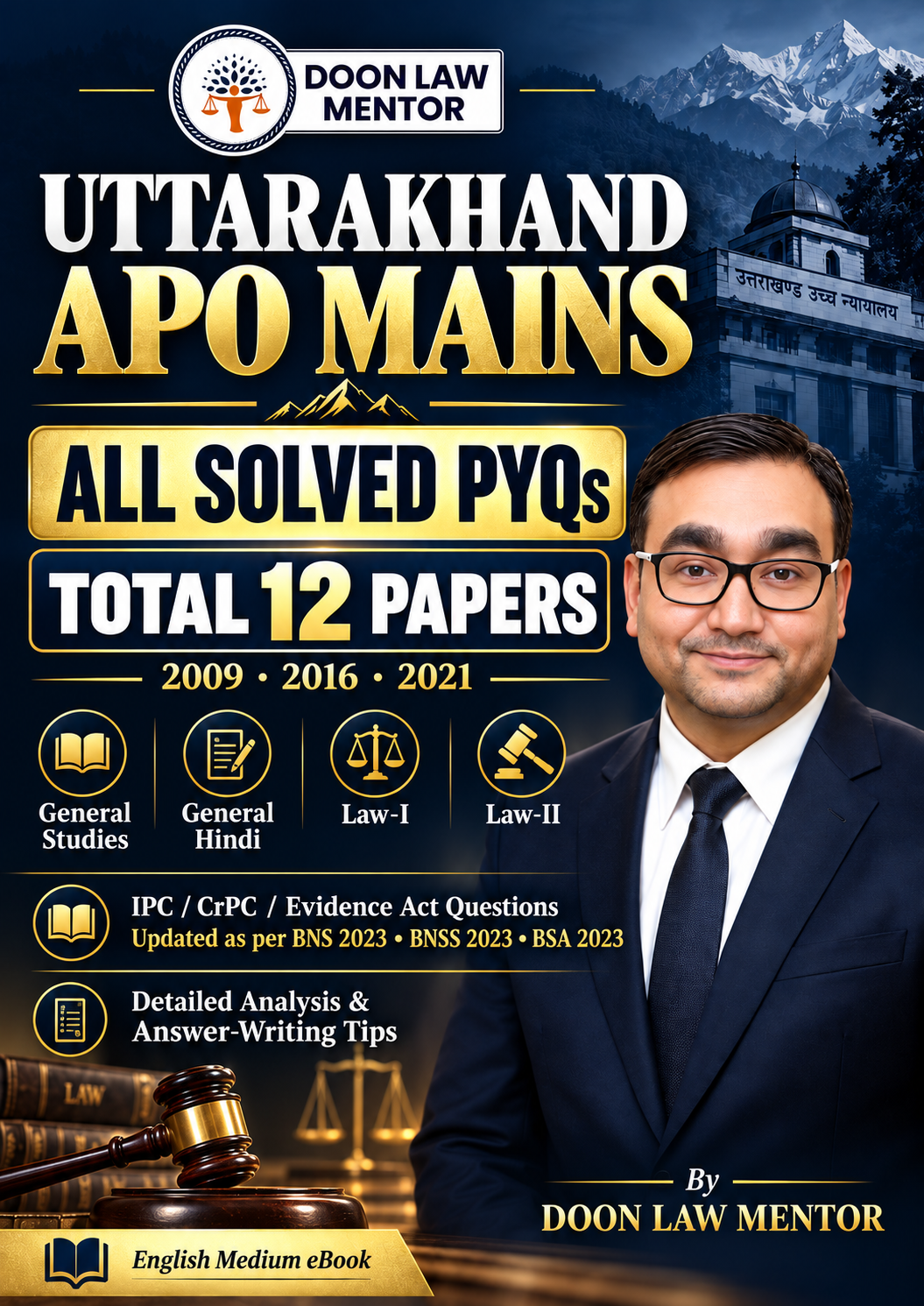
UKAPO Mains: All Solved PYQs — English
Mains PYQs solved across Law, General Studies and Language papers.
₹299View eBook ↗
Prepare the 100-mark General Hindi paper through grammar, essay, translation, drafting, legal terminology and timed written practice.
General Hindi is a full written paper in the established UKAPO Mains framework.
In the established UKAPO Mains scheme, General Hindi carries 100 marks. A candidate who postpones it until after Prelims risks losing marks in a paper where improvement comes mainly through repeated language practice.
Grammar, spelling and correct usage should become automatic through short daily revision.
Clear, concise Hindi matters more than unnecessarily ornamental language.
Previous papers help identify the type, length and pressure of the actual written tasks.
Revise standard grammar rules, sentence correctness, word usage and common error patterns.
Develop functional vocabulary, synonyms/antonyms and commonly tested language forms without memorising unusable lists.
Practise understanding passages and presenting ideas in accurate, compact Hindi.
Use previous UKPSC papers to practise the actual task formats and required answer length.
See solved General Hindi questions within the Mains PYQ collection. This paid eBook complements the free preparation guidance.
Mains PYQs solved across Law, General Studies and Language papers.
| Frequency | Task |
|---|---|
| Daily | 15–20 minutes grammar/vocabulary revision |
| 3 times a week | One focused written language exercise |
| Weekly | Timed mixed practice from previous-paper style questions |
| Fortnightly | Full review of recurring spelling/grammar mistakes |
Language skill improves through repetition, not a final-week crash.
Grammar must be converted into written practice and correction.
Readable, accurate and direct answers are safer than overcomplicated expression.
Access your UKAPO classes, notes, tests, free learning resources and preparation updates in one place.


| विषय / Task | Marks in the previously notified UKAPO syllabus framework |
|---|---|
| निबंध लेखन — लगभग 300 शब्द | 15 |
| अपठित गद्यांश | 10 |
| संक्षेपण / सारांश | 5 |
| टिप्पणी एवं प्रारूपण | 5 |
| पर्यायवाची एवं विलोम शब्द | 5 |
| समोच्चरित भिन्नार्थक शब्द तथा विराम-चिह्नों की शुद्धि | 5 |
| हिन्दी ↔ अंग्रेजी अनुवाद | 10 |
| शब्द-समूहों के लिए एक शब्द | 5 |
| उपसर्ग एवं प्रत्यय | 5 |
| अंग्रेजी की विधिक पारिभाषिक शब्दावली का हिन्दी रूपांतरण | 5 |
| अशुद्ध शब्द / वाक्य शुद्ध करना | 5 |
| मुहावरे एवं लोकोक्तियाँ | 5 |
| कार्यालयी पत्र-लेखन | 10 |
| कम्प्यूटर का कार्यालयी प्रयोग | 10 |
This is not a single “Hindi grammar” block. The paper combines language accuracy, writing, translation, official communication and practical terminology.
2–3 lines introducing the issue directly. Avoid memorised universal introductions.
Use 3–4 organised dimensions: causes, impact, legal/social context, Uttarakhand example where relevant.
Short, balanced and forward-looking. Do not introduce a completely new argument at the end.
Read the questions first, then the passage. Answer from the passage and avoid inserting outside opinion where the question asks for comprehension.
Preserve the central idea, remove repetition/examples, use your own concise language and respect the required length.
पर्यायवाची · विलोम · एक शब्द · समोच्चरित भिन्नार्थक शब्द
उपसर्ग · प्रत्यय · अशुद्ध शब्द / वाक्य शुद्धि
विराम-चिह्न · मुहावरे · लोकोक्तियाँ और वाक्य में सही प्रयोग
Maintain a recurring-error notebook. The same spelling, punctuation or usage mistake should not survive three practice sessions.
Preserve meaning, tense, legal nuance and natural sentence structure in the target language.
Practise commonly used criminal-law, court, administration and government-office expressions in both Hindi and English.
Where an official Hindi statutory term exists, prefer the official terminology rather than an improvised literal translation.
| English legal term | Your revision method |
|---|---|
| Offence / accused / evidence / witness | Write official Hindi equivalent + one sample legal sentence |
| Arrest / bail / custody / investigation | Group procedure terms together |
| Admission / confession / presumption / burden of proof | Group evidence-law terms together |
| Charge / trial / judgment / appeal / revision | Group court-process terms together |
The goal is not to memorise an enormous dictionary; it is to build reliable command over terminology likely to appear in legal and administrative writing.
Learn the structural components of an official note / draft / letter before trying to make the language impressive.
Official Hindi should be precise and functional. Avoid unnecessarily literary wording.
Write complete responses with heading, reference/context, body and appropriate closing within the expected exam time.
Prepare commonly used office-computing concepts, document handling, digital communication and basic practical terminology at the level prescribed for the paper. This is a finite area and can become a scoring block with targeted revision.
Identify which syllabus components actually appear and the length/format expected.
Language skill must survive the clock, not only look correct in an untimed notebook.
Spelling · grammar · punctuation · vocabulary · translation · format · time.
Keep short daily grammar/vocabulary revision and at least one timed writing task every week.
| Week | Main focus |
|---|---|
| 1 | Diagnostic paper + spelling / sentence correction + basic vocabulary |
| 2 | Essay + comprehension + summary |
| 3 | Translation + legal terminology |
| 4 | Official note / drafting / letter writing + office-computer component |
| 5 | Mixed timed sets + error correction |
| 6 | Full-paper practice + focused revision of recurring mistakes |
Identify the main argument before marking supporting details.
Drop examples, repetition and decorative language that are not essential to meaning.
Preserve the author’s meaning and sequence without copying long phrases.
After writing the précis, compare it with the original and ask whether any essential qualification, exception or conclusion has been lost.
| Error category | What to record |
|---|---|
| Spelling | Wrong word → correct word → one sentence |
| Grammar | Rule + your repeated error pattern |
| Vocabulary | Confusing word pair / synonym / antonym |
| Translation | Phrase that you translated unnaturally and its better equivalent |
| Drafting | Format element repeatedly forgotten |
Your final Hindi revision should come mainly from this notebook and previous-paper practice—not from reopening an entire grammar book.
Check compulsory/optional parts, word limits and translation direction before starting.
Secure marks in familiar grammar/vocabulary/drafting areas before fatigue affects accuracy.
Keep a final block for spelling, missed sub-parts and incomplete sentences.
Identify the grammar areas you repeatedly get wrong in previous-paper practice and rotate them through short daily drills. A targeted error-based cycle is more efficient than restarting an entire grammar book every month.
Rule review + 20–30 focused questions.
Mixed usage in sentences/translation.
New grammar cluster + previous-cluster retrieval.
Mixed mini-test + transfer mistakes to error notebook.
Individual exercises do not reveal time allocation. In a full paper, essay/translation/drafting can consume too much time and leave grammar or short-answer portions rushed. Use at least a few complete timed simulations based on the official/previous paper structure.
| After the paper | What to review |
|---|---|
| Completion | Did you attempt every required part? |
| Time | Which section exceeded its planned time? |
| Accuracy | Spelling, grammar and translation errors |
| Format | Drafting/essay/précis structure followed correctly? |
| Revision | Was enough time left to proofread? |
Use the official/previous UKPSC paper to understand task format, one reliable grammar reference for rules, your own error notebook for recurring mistakes and an official bilingual legal source for terminology. Adding multiple grammar books rarely improves marks if written practice remains irregular.
Previous UKPSC paper and fresh syllabus/notification.
One grammar/vocabulary reference you can revise repeatedly.
Your own corrected essays, translations, drafts and grammar mistakes—the most personalised revision material.
वर्तनी, व्याकरण, लिंग-वचन, काल, विराम-चिह्न और वाक्य संरचना में बार-बार होने वाली त्रुटियों की अपनी सूची बनाइए।
उत्तर सीधे प्रश्न के अनुरूप हो। अनावश्यक अलंकारिक भाषा या बहुत लंबे वाक्य अर्थ को कमजोर कर सकते हैं।
साफ लेखन, उचित अनुच्छेद, शीर्षक/उपशीर्षक और संतुलित spacing examiner को उत्तर समझने में सहायता करते हैं।
| Error type | What to check |
|---|---|
| Meaning distortion | Did the translation change the legal/factual meaning of the source sentence? |
| Literal translation | Did you translate word-for-word even where natural Hindi/English structure required restructuring? |
| Legal terminology | Did you use the accepted Hindi/English legal term instead of inventing an informal equivalent? |
| Grammar | Are tense, number, gender, preposition/postposition and sentence agreement correct? |
| Omission / addition | Did you leave out a qualifier or add meaning that was not present? |
Keep a bilingual legal-term glossary drawn from official Hindi/English statutes and government usage. This is more reliable than memorising improvised coaching translations.
क्या उत्तर वास्तव में दिए गए विषय पर केंद्रित है?
भूमिका, मुख्य भाग, उप-विषय और निष्कर्ष का तार्किक क्रम है या नहीं?
वाक्य सरल, स्पष्ट और व्याकरण की दृष्टि से शुद्ध हैं या नहीं?
उदाहरण, तथ्य और तर्क प्रासंगिक हैं या केवल शब्द-संख्या बढ़ा रहे हैं?
क्या उत्तर निर्धारित समय और अपेक्षित शब्द सीमा के भीतर पूरा हुआ?
| Column | What to record |
|---|---|
| गलत रूप | Your original spelling, sentence, translation or grammar mistake. |
| सही रूप | Correct version from a reliable grammar/official source. |
| त्रुटि का प्रकार | Spelling / grammar / vocabulary / translation / expression / punctuation. |
| उदाहरण | One fresh sentence using the correct rule. |
| पुनरावृत्ति | Date for retesting the same error later. |
A personalised error notebook is more useful than repeatedly reading an entire grammar book because it concentrates revision on the mistakes you actually make under exam conditions.
Practise individual grammar, précis, translation and essay components separately until the method is stable.
Combine two or three components in one timed sitting to learn switching and time allocation.
Attempt a complete paper under strict time, then audit unfinished portions, repeated language errors and time-consuming sections.
You should enter the examination knowing not only how to solve each component, but also the order in which you will attempt the paper and the maximum time you can give to each part.
| Days | Main focus | Output |
|---|---|---|
| 1–7 | Grammar diagnosis + spelling/vocabulary error collection | Personal error notebook + daily correction drill |
| 8–14 | Translation + legal terminology + précis/summary | 4–6 corrected written exercises |
| 15–21 | Essay / drafting / comprehension components | Timed long-form answers with self-review rubric |
| 22–26 | Mixed sectional practice | Combined paper blocks under time pressure |
| 27–30 | Full-paper simulation + final error revision | Complete timed papers and a last-week revision sheet |
Use your own repeated-error list, official/legal terminology glossary, previous-paper patterns and full-paper timing data. The final phase should improve reliability, not expand the syllabus endlessly.
Doon Law Mentor students have secured notable ranks in UKPSC APO.
The established Mains framework assigns 100 marks to General Hindi. The fresh notification will confirm the 2027 scheme.
Start before Prelims at a modest weekly frequency so language accuracy develops gradually.
No. Rules become useful only when you practise writing and correct repeated errors.
Yes. They help calibrate task type, time pressure and the level of written expression expected by UKPSC.
Choose between complete preparation, a Prelims-focused recorded course and structured exam practice.

Focused recorded preparation with English-medium lectures and notes, Uttarakhand GK, General Studies and complete Prelims test practice.
Complete English-medium preparation with live + recorded learning, English notes and structured guidance from Prelims to Interview.

Exam-oriented bilingual practice for aspirants who want to strengthen accuracy, speed, revision discipline and Prelims performance.
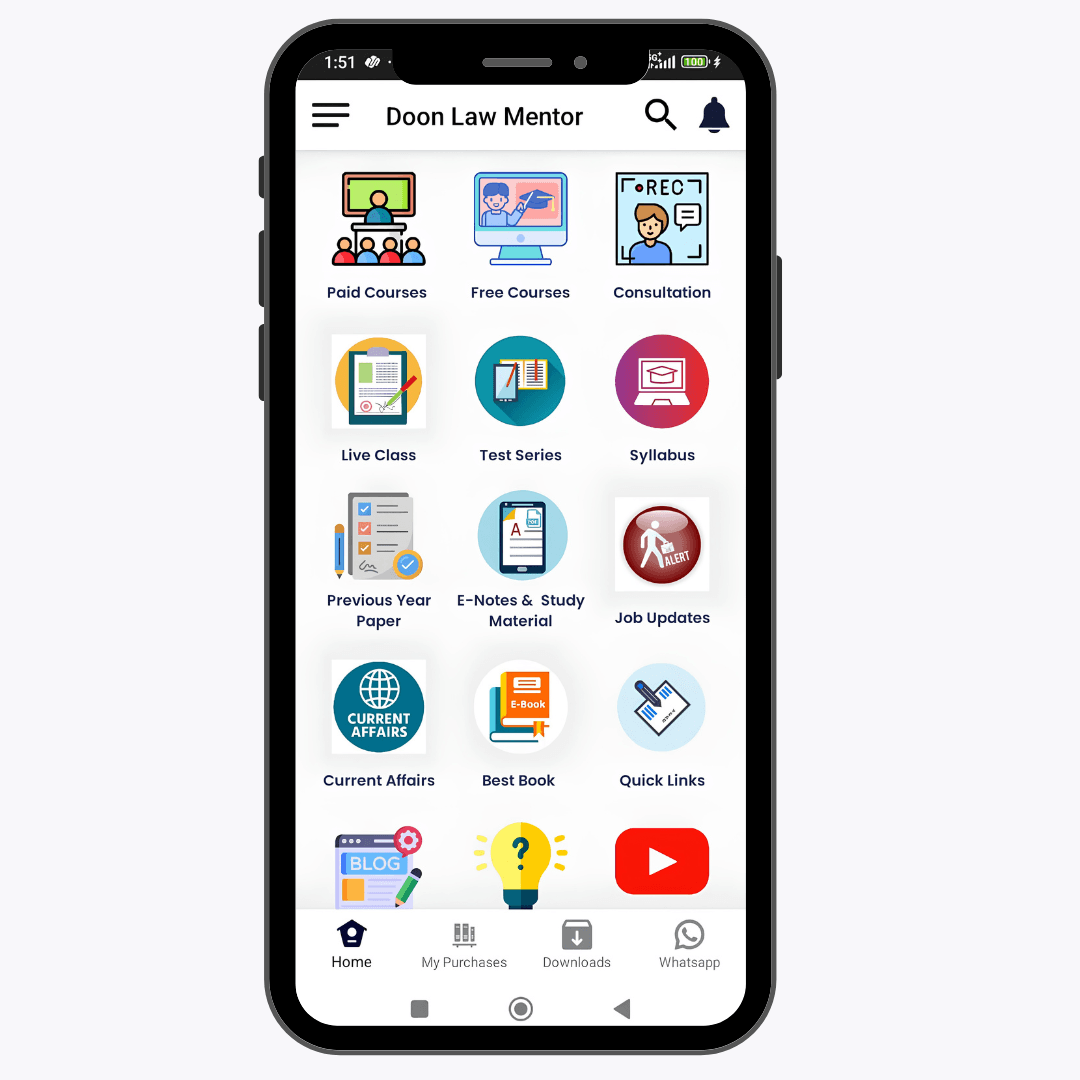
Use the Doon Law Mentor app for free learning resources and your enrolled classes, notes, tests and updates.
This page uses the established UKAPO Mains framework for preparation. The fresh UKPSC APO 2027 notification and syllabus will be final for the General Hindi paper’s marks, components and examination requirements.