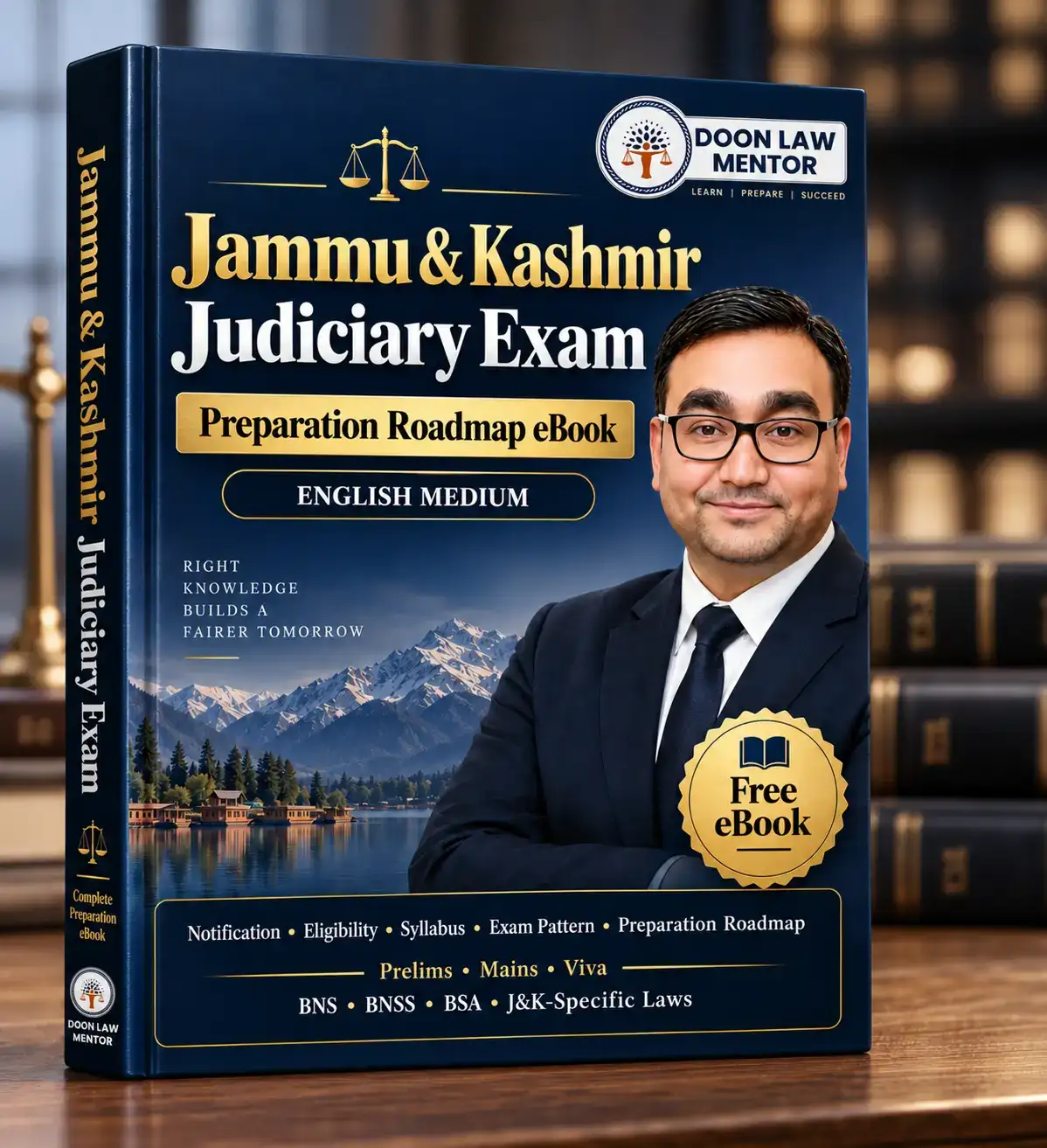




Prepare for upcoming JKPSC Civil Judge / JK CJ Exam with BNS, BNSS, BSA, J&K-specific laws, English Essay, Translation, Précis, PYQs and expert mentorship.
JKPSC Civil Judge Junior Division Exam
Civil Judge Junior Division in Subordinate Judiciary
Prelims + Mains + Viva + Physical Fitness
J&K-Specific Laws
Get Your Free e-Copy Instantly
→
Instant email delivery · English Edition · Unsubscribe anytime
Latest Update on Jammu & Kashmir Civil Judge 2026-27 Notification
Official Notification Awaited. As of September 2026, the next JKPSC Civil Judge recruitment notification is awaited. This page follows the prevailing Civil Judge framework and will be updated immediately when JKPSC issues the fresh notification. That is the preparation advantage. Aspirants who use this period to build Bare Act command, BNS–BNSS–BSA depth, J&K-specific law clarity, regular MCQ practice and Mains writing will enter the notification phase with a meaningful head start.
Jammu & Kashmir Civil Judge Exam 2026-27 Important Dates
Notification Release Date
Awaited
Online Application Start Date
To be notified
Last Date to Apply Online
To be notified
Preliminary Examination Date
To be notified
Main Written Examination Date
To be notified
Final Result
To be notified
Strategy Discussion and Media Recognition
Doon Law Mentor’s Founder Ashish Jain Sir has been featured on Doordarshan for legal-exam strategy and preparation guidance.
Recognised Media & Legal-Education Presence
Doon Law Mentor and Ashish Jain Sir have been featured across public-media, innovation and legal-education platforms.
1
Wide syllabus: Civil, criminal, constitutional and J&K-specific subjects need repeated revision.
2
Prelims accuracy: Objective testing rewards Bare Act command, coverage and disciplined attempts.
3
Mains writing: Legal expression, structure and speed cannot be built after Prelims.
4
New criminal laws: BNS, BNSS and BSA must be studied as current law from Day 1.
5
J&K-specific papers: Service regulations, court rules and tenancy law can become differentiators.
6
Language paper: Essay, Translation and Précis improve only with timed practice.
DLM Expert Insight: J&K Judiciary preparation cannot be reduced to Bare Act reading or random MCQs. Serious preparation combines Prelims accuracy, Mains writing, local-law revision, PYQ analysis, optional-paper planning and Viva orientation.
Eligibility
Who Can Apply for Jammu & Kashmir Judiciary 2026-27?
Before beginning your preparation, check the basic eligibility
conditions carefully. The domicile / residence requirement is
particularly important for J&K Civil Judge recruitment.
Mandatory Eligibility Requirement
Domicile / Residence Requirement
The candidate should be a
Domicile of the Union Territory of Jammu & Kashmir
or a
resident of the Union Territory of Ladakh.
The candidate must possess a
valid certificate issued by the Competent Authority
in the prescribed format as on the last date fixed for submission
of the online application form.
Very Important:
This is a mandatory territorial eligibility condition.
A candidate who is neither a domicile of the Union Territory
of Jammu & Kashmir nor a resident of the Union Territory
of Ladakh does not satisfy this requirement.
Educational Qualification
A candidate should possess either:
A
Bachelor’s Degree in Law
from a University established by law; or
Be a
Barrister of England or Northern Ireland,
or a
member of the Faculty of Advocates in Scotland,
or possess any other
equivalent law degree recognised by the Government of India.
Practice requirement — important transitional position:
Under the Supreme Court’s August 2026 transitional framework,
law graduates remain eligible for Civil Judge recruitment
notifications issued up to
31 March 2027,
notwithstanding the earlier 3-year practice requirement,
subject to the post-selection training and clerkship framework
directed by the Court.
Expected Age Limit
18–35 years,
subject to the relevant cut-off date and category-wise
relaxation provisions prescribed in the applicable
JKPSC recruitment notification.
Keep These Documents Ready
Date-of-birth / age proof
LL.B. degree and academic records
Identity proof
J&K Domicile Certificate or applicable Ladakh
Residence Certificate
Category / reservation certificate, where applicable
Any other certificate prescribed by JKPSC
in the recruitment notification
Eligibility Check Before Applying:
Educational qualification, age and the prescribed domicile /
residence condition must all be satisfied independently.
Possessing an LL.B. degree by itself does not satisfy the
territorial eligibility requirement.
The prevailing JKPSC Civil Judge Preliminary Examination consists
of two objective papers.
Paper
Marks
Duration
Paper A
225 Marks
2 Hours
Paper B
225 Marks
2 Hours
Total
450 Marks
4 Hours
Why Prelims is Very Important
Prelims is the first major filter. It rewards statutory recall,
wide syllabus coverage, time management and accuracy. The prevailing
JKPSC framework also provides negative marking for incorrect answers,
so preparation must include controlled attempts and elimination technique.
DLM Expert Insight:
Prelims is not only a knowledge test. Your revision cycle, accuracy
and ability to move between general law and J&K-specific rules
can decide qualification.
The
JKPSC Civil Judge syllabus
covers two Preliminary Examination papers, compulsory and
optional Mains papers and Viva-Voce. Explore the detailed
subject-wise
J&K Judiciary syllabus
below for preparation for the upcoming recruitment cycle.
The presently available official JKPSC Civil Judge syllabus
still refers to the
Jammu and Kashmir Residential and Commercial Tenancy Act, 2012
.
However, the 2012 Act has been repealed by
Section 47 of the
Jammu and Kashmir Tenancy Act, 2025
,
and the 2025 Act came into force on
15 February 2026.
Therefore, for the upcoming recruitment cycle, aspirants should
prepare the
Jammu and Kashmir Tenancy Act, 2025
as the current tenancy law, while also checking the fresh JKPSC
notification/syllabus for the Commission's final prescribed wording.
JKPSC Civil Judge Prelims Paper A Syllabus
Paper A combines General Knowledge, Indian Constitutional Law,
the three new criminal laws and the Limitation Act, 1963.
General Knowledge
Indian Constitutional Law
Bharatiya Nagarik Suraksha Sanhita, 2023 — BNSS
Bharatiya Sakshya Adhiniyam, 2023 — BSA
Bharatiya Nyaya Sanhita, 2023 — BNS
Limitation Act, 1963
Paper A Preparation Focus:
Build constitutional law and the three new criminal laws around
Bare Act accuracy, conceptual clarity, PYQs and repeated objective
revision rather than relying only on explanatory notes.
Paper A Preparation Guide
Need a complete strategy for J&K Civil Judge Paper A?
Go beyond the syllabus with a subject-wise preparation plan for
General Knowledge, Constitutional Law, BNS, BNSS, BSA and the
Limitation Act, including Bare Act reading, PYQs, revision cycles,
mock-test planning and negative-marking strategy.
Detailed Topic Coverage for JKPSC Civil Judge Prelims Paper A
Use the following topic-wise coverage as a preparation checklist
while studying Paper A.
Indian Constitutional Law — Important Topics for J&K Judiciary
Preamble and basic constitutional philosophy
Citizenship
Fundamental Rights
Directive Principles of State Policy
Fundamental Duties
Doctrine of judicial review
Writ jurisdiction and constitutional remedies
Union and State Executive
Parliament and State Legislatures
Supreme Court and High Courts
Centre-State legislative and administrative relations
Distribution of legislative powers
Emergency provisions
Constitutional amendment and Basic Structure doctrine
Constitutional and statutory bodies frequently tested in competitive examinations
Important constitutional doctrines and landmark Supreme Court principles
BNSS Topics for JKPSC Civil Judge Preparation
Constitution and powers of criminal courts
Arrest and safeguards relating to arrested persons
Processes to compel appearance and production of things
Information to police and investigation
Search, seizure and investigation-related powers
Jurisdiction of criminal courts in inquiries and trials
Initiation of proceedings before Magistrates
Complaints to Magistrates
Charge and joinder of charges
Trial before different criminal courts
Summary trials
Bail and bonds
Maintenance of public order and tranquility
Evidence during inquiries and trials
Judgment and sentencing procedure
Appeal, reference and revision
Limitation for taking cognizance
Electronic and technology-enabled procedural changes under BNSS
Major changes from the repealed CrPC frequently relevant for Prelims
BSA Topics for JKPSC Civil Judge Preparation
Definitions and fundamental concepts of evidence
Relevancy of facts
Facts forming part of the same transaction
Motive, preparation and conduct
Admissions
Confessions
Statements by persons who cannot be called as witnesses
Dying declarations
Judgments of courts when relevant
Expert opinion and opinion evidence
Character when relevant
Facts which need not be proved
Oral evidence
Documentary evidence
Electronic and digital records
Public and private documents
Presumptions relating to documents and electronic records
Burden of proof
Estoppel
Competency and examination of witnesses
Major changes introduced by BSA over the Indian Evidence Act
BNS Topics for JKPSC Civil Judge Preparation
Definitions and general explanations
Punishments
General Exceptions
Right of private defence
Abetment
Criminal conspiracy
Attempt
Offences against women and children
Offences affecting the human body
Culpable homicide and murder
Hurt and grievous hurt
Wrongful restraint and wrongful confinement
Kidnapping and abduction
Offences against the State
Offences against public tranquility
Offences relating to public servants and administration of justice
Offences against property
Theft, extortion, robbery and dacoity
Criminal breach of trust and cheating
Mischief and criminal trespass
Forgery and document-related offences
Defamation
New offences and important structural changes introduced by BNS
Limitation Act, 1963 — Important Topics for Prelims
Bar of limitation
Extension of prescribed period in certain cases
Legal disability
Continuous running of time
Computation of limitation
Exclusion of time in legal proceedings
Effect of death before accrual of right to sue
Effect of fraud and mistake
Acknowledgment in writing
Effect of payment on account of debt or interest
Continuing breaches and continuing torts
Acquisition of easements by prescription
Extinguishment of right to property
Structure and frequently tested periods contained in the Schedule
JKPSC Civil Judge Prelims Paper B Syllabus
Paper B combines General Financial Rules, J&K Service Regulation,
subordinate court material and core civil laws. It requires a separate
provision-based preparation strategy.
General Financial Rules, 2017
Jammu and Kashmir Service Regulation, 1956 —
Chapters III to XIII, XXII and XXIII
Rules and Orders for the Guidance of Subordinate Courts
(Civil and Criminal) and High Court Circular Orders
Code of Civil Procedure, 1908
Registration Act, 1908
Transfer of Property Act, 1882
J&K Tenancy Act, 2025 — current-law preparation
DLM Expert Insight:
Paper B can become a scoring differentiator because many candidates
are comfortable with CPC and TPA but comparatively weak in service
regulations, subordinate court rules, High Court circulars and
J&K-specific law.
Paper B Preparation Guide
Need a complete strategy for J&K Civil Judge Paper B?
Go beyond the syllabus with a structured preparation plan for
GFR, J&K Civil Service Regulations, subordinate-court rules,
High Court circulars, CPC, Registration, TPA and current tenancy law,
including PYQs, rule-based revision, mock tests and a 30-day framework.
The linked official compilation is updated up to
31 January 2026.
Candidates should also remain alert to subsequent amendments
and instructions issued by the Department of Expenditure.
J&K Service Regulation, 1956 — Chapters III–XIII, XXII & XXIII
The prescribed portion should be read chapter-wise with special
attention to rules, exceptions, competent authorities and procedural
requirements.
Chapter III:
General Rules relating to service, age, health, employment,
lien and allied matters
Chapter IV:
Additions to salary and deputations
Chapter IV-A:
Government residences and related rent provisions
Chapter V:
Officiating Allowances — General Rules
Chapter VI:
Officiating Allowance and its calculation
Chapter VII:
Regulation of pay and allowances in progressive or
time-scale appointments
Chapter VIII:
Combination of appointments and salaries
Chapter IX:
Joining time
Chapter X:
Officers dismissed, suspended or imprisoned
Chapter XI:
General conditions of leave
Chapter XII:
Short leave
Chapter XIII:
Long leave
Chapter XXII:
Application for and grant of leave
Chapter XXIII:
Payment of leave allowances
For Prelims, pay particular attention to definitions, conditions,
exceptions, competent authorities, time limits and consequences
arising from non-compliance with the rules.
Subordinate Court Rules & High Court Circular Orders — What to Prepare
Rules governing civil and criminal subordinate courts
Institution and processing of judicial proceedings
Issue and service of processes
Summons, warrants and procedural court documents
Registers maintained by subordinate courts
Judicial and administrative record management
Inspection of court records
Certified copies and copying procedure
Preservation, transmission and consignment of records
Deposits, accounts and court-related administrative procedure
Responsibilities of judicial and ministerial court staff
Directions contained in important High Court Circular Orders
Differences between civil and criminal court procedure
wherever specifically prescribed
This subject should be prepared directly from the prescribed rules
and circulars because objective questions may turn on exact procedural
language.
Code of Civil Procedure, 1908 — High-Yield Prelims Topics
Jurisdiction of civil courts
Res sub judice and res judicata
Place of suing
Parties to suits
Joinder and misjoinder
Pleadings
Plaint and written statement
Return and rejection of plaint
Set-off and counterclaim
Issue and service of summons
Appearance and non-appearance of parties
Ex parte proceedings
Discovery, inspection and admissions
Settlement of issues
Interim and interlocutory orders
Temporary injunctions
Commissions
Judgment, decree and order
Execution of decrees
Appeals
Reference, review and revision
Suits by or against Government
Special suits and miscellaneous proceedings
Inherent powers of the court
Registration Act, 1908 — Important Topics for JKPSC Civil Judge
Documents of which registration is compulsory
Documents of which registration is optional
Time for presentation of documents
Place of registration
Persons entitled to present documents
Appearance before registering officers
Enquiry before registration
Admission and denial of execution
Refusal to register
Appeal and application against refusal
Effect of registration
Effect of non-registration
Priority of registered documents
Powers and duties of registering officers
Penalties and offences under the Act
Transfer of Property Act, 1882 — Important Topics for Prelims
Meaning and essentials of transfer of property
What may and may not be transferred
Competency to transfer
Conditions restraining alienation
Vested and contingent interests
Doctrine of election
Transfer by ostensible owner
Feeding the grant by estoppel
Doctrine of lis pendens
Fraudulent transfers
Doctrine of part performance
Sale of immovable property
Mortgages and charges
Rights and liabilities of mortgagor and mortgagee
Redemption and foreclosure
Lease
Exchange
Gift
Actionable claims
J&K Tenancy Act, 2025 — Important Topics for 2026–27 Preparation
Because this is the current tenancy legislation for J&K,
students should build a separate updated-law revision sheet around
its institutional and procedural framework.
Object, extent and application of the Act
Important statutory definitions
Tenancy agreement and information to the Rent Authority
Period and renewal of tenancy
Restriction on sub-letting
Rent payable and revision of rent
Security deposit
Rights and obligations of landlords and tenants
Payment and deposit of rent
Repair and maintenance obligations
Essential services
Eviction and recovery of possession
Consequences after expiry of tenancy
Rent Authority — constitution, powers and procedure
Appeals from the Rent Authority
Rent Court and Rent Tribunal
Procedure, jurisdiction and execution of orders
Bar of civil-court jurisdiction in matters governed by the Act
The Mains examination is descriptive. Under the prevailing scheme,
candidates take 6 compulsory papers and choose 3 of the 6
optional-paper groups. Each paper carries 100 marks and is of 3 hours.
Particular
Details
Type
Descriptive / Written
Compulsory Papers
6 Papers
Optional Papers
Choose 3 out of 6 optional-paper groups
Marks per Paper
100 Marks
Duration per Paper
3 Hours
Why Mains Requires a Different Strategy
Prelims tests recognition. Mains tests expression. A good answer
should show the relevant provision, legal concept, application,
reasoning and a clear conclusion.
1
Identify the Issue
Begin with a clear introduction and correctly identify
the legal issue involved.
2
State the Relevant Law
Mention the applicable statutory provision, rule or
legal principle accurately.
3
Explain the Legal Principle
Demonstrate conceptual clarity and support the answer
with the correct legal reasoning.
4
Apply and Conclude
Apply the law to the issue and finish with a concise,
reasoned conclusion.

English Essay · Translation from English into Urdu/Hindi
and vice versa · Précis
Paper II
General Knowledge · Indian Constitutional Law
Paper III
BNSS · BSA · BNS
Paper IV
General Financial Rules · J&K Service Regulation ·
Rules and Orders for the Guidance of Subordinate Courts
(Civil and Criminal) · High Court Circular Orders
Paper V
Code of Civil Procedure · Limitation Act · Registration Act
Paper VI
Transfer of Property Act · J&K tenancy law
How to Prepare the Compulsory Papers for Mains
Paper I — English Essay, Translation & Précis Preparation
Essay structure: introduction, issue development and conclusion
Legal and constitutional essay themes
Rule of law and constitutional governance
Access to justice and judicial reforms
Technology and administration of justice
Contemporary legal and socio-legal issues
Translation of ordinary and legal passages
Accurate legal vocabulary
Grammar, sentence structure and meaning preservation
Précis writing and identification of the central idea
Compression without distortion of meaning
Timed weekly writing practice
Papers II–VI — Legal Answer Writing Strategy
The substantive syllabus substantially overlaps with Prelims,
but the examination demand changes from recognition to legal
articulation and application.
Identify the legal issue raised by the question.
State the governing statutory provision or relevant rule accurately.
Explain the legal principle in clear and precise language.
Add relevant case law where it genuinely strengthens the answer.
Apply the provision to the facts in problem-based questions.
Distinguish related doctrines where the examiner is testing conceptual differences.
Conclude directly instead of repeating the introduction.
Practise writing within the actual examination time constraint.
DLM Expert Insight:
Prepare overlapping Prelims–Mains subjects once at two depths:
statutory accuracy for objective questions and structured
legal reasoning for descriptive answers.
JKPSC Civil Judge Optional Papers
Candidates choose 3 optional-paper groups from the available
options. Optional selection should be based on conceptual comfort,
source availability, PYQs and the ability to write descriptive answers.
Optional Paper I
Hindu Law · Mohammedan Law
Optional Paper II
Law of Companies · Insurance Law
Optional Paper III
Principles of Equity · Law of Trusts · Specific Relief
Optional Paper IV
Indian Contract Act, 1872 · Law of Torts
Optional Paper V
Suits Valuation · Court Fees · Indian Stamp law ·
Excise law and Rules
Optional Paper VI
Land Revenue law · Right to Fair Compensation and
Transparency in Land Acquisition, Rehabilitation and
Resettlement Act, 2013
Optional Paper III — Equity, Trusts & Specific Relief
Nature and origin of equity
Important equitable maxims
Equitable rights and remedies
Creation and classification of trusts
Duties and liabilities of trustees
Rights and liabilities of beneficiaries
Breach of trust
Extinction of trusts
Recovery of possession
Specific performance of contracts
Contracts not specifically enforceable
Rectification of instruments
Rescission
Cancellation of instruments
Declaratory relief
Temporary, perpetual and mandatory injunctions
Optional Paper IV — Contract & Torts
Offer and acceptance
Consideration
Capacity to contract
Free consent
Void and voidable agreements
Contingent contracts
Performance and discharge
Breach and damages
Quasi-contractual obligations
Indemnity and guarantee
Bailment and pledge
Agency
General principles of tortious liability
Negligence
Nuisance
Defamation
Vicarious liability
Strict and absolute liability
Remoteness of damage
General defences and remedies
Optional Paper V — Suits Valuation, Court Fees, Stamp & Excise
Principles governing valuation of suits
Relationship between jurisdictional value and court-fee valuation
Computation and payment of court fees
Deficient court fee and consequences
Refund of court fees where permissible
Chargeability of instruments to stamp duty
Proper stamping of instruments
Adjudication regarding stamp duty
Impounding of insufficiently stamped instruments
Effect of instruments not duly stamped
Relevant J&K excise authorities and regulatory structure
Licensing and permissions under applicable excise law
Excise duties, offences, penalties and procedural provisions
Optional Paper VI — Land Revenue & RFCTLARR Act, 2013
Revenue authorities and their powers
Revenue records and record-of-rights
Mutation and entries in revenue records
Assessment and collection of land revenue
Partition and revenue proceedings
Appeals, review and revision under revenue law
Important definitions under the RFCTLARR Act, 2013
Social Impact Assessment
Preliminary notification and acquisition procedure
Determination of compensation
Award by the Collector
Rehabilitation and Resettlement
Special safeguards and statutory entitlements
Land Acquisition, Rehabilitation and Resettlement Authority
Reference, appeal and enforcement-related provisions
Optional Selection Strategy:
Do not select an optional merely because its syllabus looks short.
Compare your existing subject command, Bare Act comfort, PYQ demand,
available preparation material and answer-writing confidence.
High-Priority Criminal Laws
BNS · BNSS · BSA for J&K Judiciary
Prepare the three new criminal laws directly from the Bare Acts,
with provision-level accuracy for Prelims and structured application
for Mains.
Relevancy, admissions, confessions, documentary and electronic
evidence, burden of proof and witnesses.
Official statutory texts:
Act names above link directly to India Code, Government of India.
Preparation Focus:
Bare Act accuracy for Prelims + issue, provision, application
and reasoning for Mains.
J&K-Specific Preparation
J&K-Specific Laws and Court Rules for Judiciary
J&K-specific statutory and administrative material deserves
a separate revision track. These areas should not be mixed casually
with the general civil-law syllabus.
General Financial Rules, 2017
Jammu and Kashmir Service Regulation, 1956
— Chapters III to XIII, XXII and XXIII
Rules and Orders for the Guidance of Subordinate Courts
(Civil and Criminal) and High Court Circular Orders
J&K Tenancy Act, 2025
Land Revenue law for the relevant optional paper
Excise law and Rules for the relevant optional paper
Important authorities, procedures, powers, timelines
and rule-based examination points
Preparation Method:
For every J&K-specific subject, prepare the exact applicable
chapters or rules, important definitions, authorities, powers,
procedures, timelines and frequently testable statutory language.
These subjects should have their own short revision notes and MCQ cycle.
English Essay, Translation and Précis for JK Judiciary Mains
Paper I is highly improvable if you practise it every week instead of postponing it to the final month.
English Essay
Legal and constitutional themes · Rule of law · Access to justice · Judicial reforms · Current socio-legal issues
Translation
English ↔ Hindi / Urdu as permitted · Legal vocabulary · Accuracy · Grammar · Sentence structure · Timed practice
Précis
Central idea · Concise expression · Logical flow · Clear language · Word-limit discipline
DLM Expert Insight: Paper I can improve your Mains score because performance is driven by practice, not merely reading.
Official Previous Year Papers
J&K Judiciary Previous Year Question Papers (PYQs) for 2026-27 Preparation
Access JKPSC Civil Judge Prelims and Mains question papers
year-wise through official JKPSC PDF links.
✓
Official Source:
Every question-paper link below opens the PDF hosted on the
Jammu & Kashmir Public Service Commission website.
Detailed PYQ Resource
Want more than just previous-year paper PDFs?
Explore paper-wise trends, subject-level analysis, recurring
high-yield areas, J&K-specific law questions, old-code to
BNS/BNSS/BSA mapping and a practical PYQ strategy for 2027 preparation.
How to use PYQs:
Attempt each paper under exam conditions, identify recurring
provisions and J&K-specific areas, and convert mistakes into
your next revision cycle.
Free Resources
Start with Free J&K Judiciary Preparation Resources
Begin with the preparation roadmap, previous-year resources
and expert strategy videos before moving into structured
J&K Judiciary preparation.
Start Here
J&K Judiciary Preparation Roadmap eBook
Understand the JKPSC Civil Judge examination, eligibility,
Prelims and Mains structure, syllabus priorities and the
preparation sequence you should follow.
Study previous-year papers and exam-oriented resources
to understand recurring areas, statutory depth and the
actual demand of JKPSC Civil Judge examinations.
Use these free sessions to understand the examination,
syllabus priorities, J&K-specific subjects and the preparation
approach required for Prelims, Mains and Viva-Voce.
Understand how to approach JKPSC Civil Judge preparation
and organise your study for the examination.
Prelims Paper A & Paper B Strategy
Video Coming Soon
Prelims Strategy
JKPSC Civil Judge Prelims Paper A & Paper B Strategy
Suggested future video covering subject priority,
Bare Act revision, J&K-specific portions, MCQ practice
and the correct approach to both Prelims papers.
Mains & Answer Writing Strategy
Video Coming Soon
Mains Strategy
J&K Judiciary Mains & Answer Writing Strategy
Suggested future session on 6 compulsory papers,
optional-paper planning, legal answer structure,
Essay, Translation, Précis and regular writing practice.
J&K-Specific Laws Strategy
Video Coming Soon
J&K Specific
How to Prepare J&K-Specific Laws for Civil Judge Exam
Suggested future video covering General Financial Rules,
J&K Service Regulation, Subordinate Court Rules,
High Court Circular Orders and the J&K Tenancy Act, 2025.
How to use these free sessions:
First understand the exam structure and preparation priorities,
then move into Bare Act study, PYQs, regular MCQ practice,
Mains answer writing and J&K-specific law revision.
Meet Your Mentor
Learn from Ashish Jain Sir — Founder, Doon Law Mentor
Known for simplifying complex Bare Acts, new criminal laws and examination concepts for Prelims, Mains and Interview preparation.
14+ Years of Law-Teaching Experience
UGC-NET & JRF in Law
Mentor of Change, Atal Innovation Mission, NITI Aayog
Former Assistant Professor of Law — ICFAI University & UPES
LL.M., Faculty of Law, University of Delhi
LL.B., Campus Law Centre, University of Delhi
Teaching philosophy: simplify complex Bare Acts, connect provisions with concepts and exam demand, and build legal clarity through structured revision and practice.
Results & Student Experiences
Trusted by Judiciary, APO & Law Aspirants
Doon Law Mentor students have used our courses, Bare Act-focused
teaching, test practice, answer-writing support and personalised
mentoring across Judiciary, APO and other competitive law examinations.
4.9 / 5
Google Business Rating
63 Reviews
50+
Judiciary & APO Selections
DLM Results
10,000+
Law Students Mentored
DLM Community
Selected Candidates & Top Rankers
Published DLM success stories from Judiciary and APO examinations.
UKPCSJ · Rank 2
Srishti Baniyal
Uttarakhand Judicial Services
Srishti credits DLM’s comprehensive lectures,
study material, expert guidance and mock-interview
preparation with strengthening her Judiciary preparation.
Judiciary · Rank 11
Kajal Rani
Judicial Services Selection
Kajal highlights personalised guidance, detailed subject
coverage and the confidence she developed during her
preparation with Doon Law Mentor.
UKAPO · Rank 27
Gourav Agarwal
Selected as Assistant Prosecution Officer
Gourav has credited Ashish Jain Sir’s guidance,
preparation support and mentoring with helping him
approach the APO examination with greater direction
and confidence.
Candidate Conversation
Hear Directly from Selected Candidates
Students discuss preparation strategy, Bare Act focus,
mock practice, interview readiness and the role of
structured mentoring during their examination journey.
Bare Act-focused preparation
PYQ and mock-test practice
Exam strategy and revision planning
Interview and personality guidance
What Students Say About the DLM Learning Experience
Published student feedback also consistently highlights
concept clarity, detailed teaching, practical examples,
doubt support and the DLM mobile learning experience.
RD
Rishabh Deep
DLM Student
Appreciates Ashish Sir’s clear teaching style,
detailed explanations and focus on resolving student doubts.
DLM Academy Review
SB
Simran Bhaskar
Judiciary Aspirant
Highlights detailed Judiciary sessions, practical examples,
case-law-rich study material and strong mentorship.
DLM Student Review
IM
Ishan Mathur
Judiciary Student
Describes his DLM experience as highly knowledgeable,
with stronger conceptual clarity and consistent support
for clearing doubts.
DLM Academy Review
AJ
Aakansha Jain
DLM App User
Highlights the DLM app’s smooth learning experience,
access to current affairs, previous-year papers and
high-quality video courses for law-exam preparation.
DLM App / Student Review
Transparency:
Transparency Note: The student results and reviews above reflect Doon Law Mentor’s broader Judiciary and APO mentoring experience. The named selections shown are from their respective examinations and are not presented as J&K Civil Judge selections.
Online Preparation Options for Jammu & Kashmir Judiciary 2026-27
Choose the level of preparation support that matches your current stage —
complete preparation, Prelims test practice, or access to all J&K Judiciary courses.
Complete Preparation
J&K Judiciary Complete Course
Structured preparation for the JKPSC Civil Judge examination
covering Prelims, Mains and Viva.
Why Choose Doon Law Mentor for Jammu & Kashmir Judiciary?
Choosing the right guidance can save months of confusion. The focus is on updated, structured and exam-oriented preparation.
Judiciary-Focused
Preparation aligned to Prelims, Mains and Viva demand.
Updated Criminal Laws
BNS, BNSS and BSA integrated across objective and descriptive preparation.
J&K-Specific Focus
Special rules and local-law material receive a separate revision strategy.
PYQ-Led Priority
Use real exam demand to decide what deserves deeper revision.
Prelims + Mains Together
Avoid beginning descriptive preparation only after Prelims.
Testing + Revision
Convert learning into recall through tests, error analysis and revision loops.
Our Preparation Philosophy: Legal education should be simple, structured and result-oriented. Aspirants should not feel lost between Bare Acts, old notes, random PDFs and scattered videos.
Avoid These Mistakes
Why Most J&K Judiciary Aspirants Struggle
1. Waiting for the notification before beginning serious preparation.
2. Preparing only Prelims MCQs and postponing Mains writing.
3. Using outdated criminal-law material instead of BNS, BNSS and BSA.
4. Treating J&K-specific rules and local laws as low-priority.
5. Leaving Essay, Translation and Précis for the final month.
6. Choosing optional papers without checking syllabus and PYQs.
7. Reading repeatedly without tests, error analysis or revision cycles.
8. Using too many scattered sources instead of one preparation system.
J&K Judiciary 2026-27 Preparation Timeline
Divide the syllabus into a sequence that builds knowledge first and exam performance later.
1
Foundation Stage
Pattern, core laws, Bare Acts and J&K orientation.
2
Concept + Bare Act Stage
Deep statutory understanding and important provisions.
3
Practice Stage
MCQs, PYQs, short answers and full Mains answers.
4
Revision + Test Stage
Full mocks, analysis and weak-area improvement.
Final Advice: Do not wait for the notification to start. The syllabus is wide and the writing component needs time.
Personal Profile, Judicial Motivation & Personality Questions
Introduce yourself in a structured and professional manner
Why do you want to join the Judiciary?
Why Civil Judge rather than litigation or another legal career?
Academic background and law-school subjects
Employment or litigation experience, where applicable
Strengths and areas requiring improvement
Hobbies and interests
Home district and local issues
Role and responsibilities of a Civil Judge
Qualities expected from a judicial officer
Impartiality, patience and courtroom temperament
Handling pressure, workload and difficult litigants
Legal, Constitutional & Practical Court Questions
Constitutional values and judicial independence
Rule of law and access to justice
Natural justice
Judicial ethics
Recusal and conflict of interest
BNS, BNSS and BSA developments
CPC and basic civil-court procedure
Evidence and burden of proof
Bail and procedural safeguards
Interim relief and injunctions
Execution of decrees
Problem-based factual situations
Courtroom management scenarios
Balancing technical procedure with substantive justice
Jammu & Kashmir, Current Legal Issues & Judicial Awareness
Basic administrative and institutional structure of the Union Territory
Important J&K-specific laws appearing in the examination syllabus
J&K High Court and subordinate judiciary structure
Current legal developments affecting civil and criminal justice
Important recent Supreme Court and High Court judgments
Technology and digitisation of courts
Artificial intelligence and the justice system
Access to justice and legal aid
Case pendency and judicial delay
Mediation and Alternative Dispute Resolution
Gender justice and protection of vulnerable groups
Environmental and socio-legal issues relevant to the region
Balanced responses to contemporary legal controversies
DLM Expert Insight:
A future Civil Judge should demonstrate legal clarity,
constitutional commitment, fairness, patience, practical judgment
and the ability to remain balanced under pressure.
FAQs
Frequently Asked Questions on J&K Judiciary Exam 2026–27
As of September 2026, the next JKPSC Civil Judge recruitment
notification is awaited. Aspirants should therefore prepare for
the upcoming recruitment cycle rather than depend on a particular
year label. Doon Law Mentor is covering the prevailing
JKPSC Civil Judge syllabus and exam pattern for 2026–27
preparation, and this page will be updated when JKPSC issues
the fresh official notification.
The Jammu & Kashmir Public Service Commission (JKPSC)
conducts recruitment for Civil Judge (Junior Division)
in the Subordinate Judiciary.
The prevailing Preliminary Examination has Paper A and Paper B.
Paper A includes General Knowledge, Indian Constitutional Law,
BNSS, BSA, BNS and the Limitation Act. Paper B covers General
Financial Rules, the prescribed chapters of the Jammu and Kashmir
Service Regulation, Subordinate Court Rules and High Court Circular
Orders, CPC, Registration Act, Transfer of Property Act and
the applicable J&K tenancy law.
The expected age range is 18–35 years, subject to the applicable
cut-off date, category-wise relaxations and any changes contained
in the fresh JKPSC recruitment notification.
Under the Supreme Court’s August 2026 transitional framework,
law graduates are eligible for Civil Judge recruitment
notifications issued up to 31 March 2027 notwithstanding the
earlier three-year practice requirement, subject to the
applicable post-selection training and clerkship directions.
Under the prevailing structure, the Preliminary Examination
consists of Paper A and Paper B. Each paper carries 225 marks
and is of 2 hours, giving a total of 450 marks.
Yes. The prevailing JKPSC examination framework provides
negative marking for incorrect answers under the applicable
Conduct of Examination Rules.
The prevailing Mains scheme has 6 compulsory papers and
3 optional papers selected from 6 optional-paper groups.
Each paper carries 100 marks and is of 3 hours.
Viva-Voce carries 140 marks under the prevailing
J&K Civil Judge examination scheme.
This page provides year-wise JKPSC Civil Judge previous year
question papers for 2025, 2023 and 2018, with direct links to
the official JKPSC-hosted PDFs for Prelims and Mains papers.
Mains answer writing should begin during Prelims preparation.
The subject overlap is substantial, while provision recall,
legal structure, application and writing speed require
sustained practice.
Start by understanding the complete JKPSC Civil Judge syllabus
and exam pattern. Then build an integrated preparation routine
covering Bare Acts, BNS, BNSS, BSA, J&K-specific laws,
MCQs, previous year papers, Mains answer writing and revision.
Your Next Step
Start Your Jammu & Kashmir Judiciary 2026-27 Preparation with Doon Law Mentor
Build one structured preparation system for Bare Acts,
Prelims MCQs, Mains answer writing, J&K-specific laws,
PYQs, revision and Viva preparation.
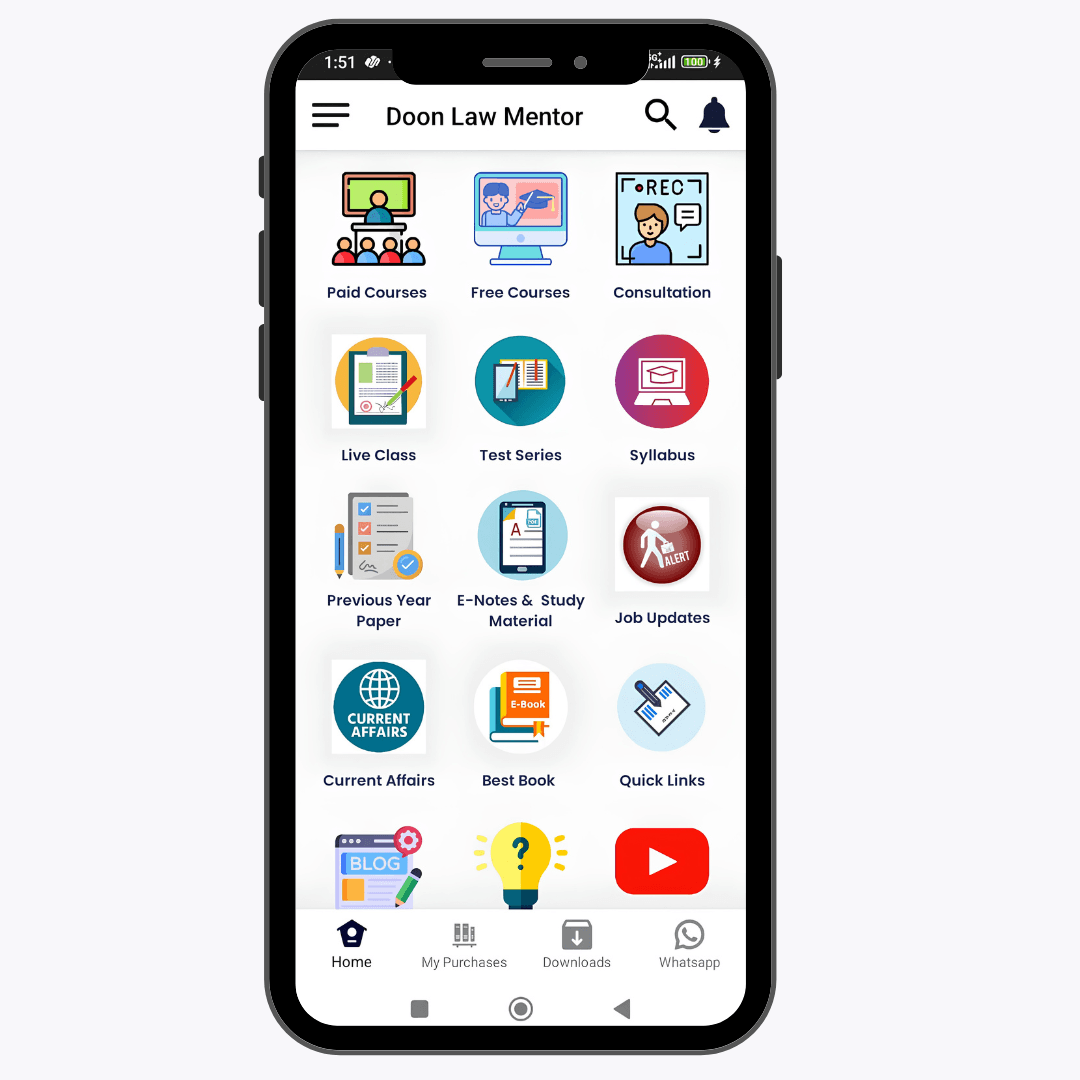
Access learning resources through the Doon Law Mentor app and keep your preparation organised on mobile.
All Resources at One PlaceClasses, notes, PDFs and tests.
Instant UpdatesStay connected with course updates.
Tests & PracticeAttempt mock tests and quizzes.
Track Your LearningResume lessons and organise study.
Download the Doon Law Mentor App
Disclaimer
The fresh JKPSC Civil Judge notification is awaited. Exam pattern, eligibility and syllabus information on this page follows the prevailing JKPSC Civil Judge framework for preparation purposes and will be updated if the fresh notification introduces any change. Candidates should verify recruitment-specific dates, vacancies, fee, cut-off dates and conditions from JKPSC when notified.