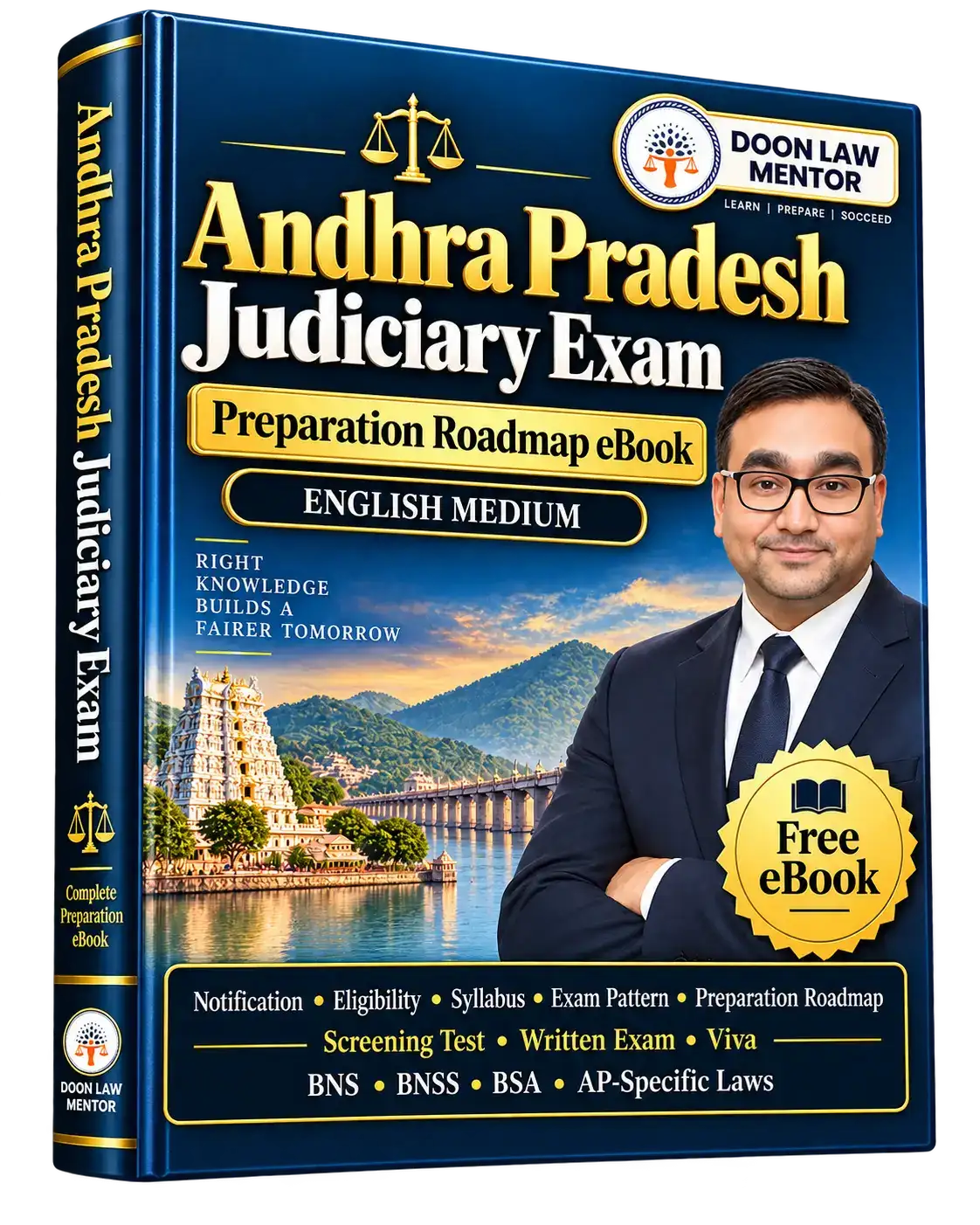
Start with the Free AP Civil Judge Preparation Roadmap
Get the free preparation eBook to understand the exam structure, priority areas and the sequence in which you should build your AP Civil Judge preparation.
Official-notification based preparation for Andhra Pradesh Civil Judge (Junior Division) 2026.

English Edition · Instant Digital Access
Andhra Pradesh Civil Judge (Junior Division) recruitment is commonly searched as AP Civil Judge, AP CJ, AP JCJ and Andhra Pradesh Judiciary Exam.
| Particular | Details |
|---|---|
| Exam | Andhra Pradesh Civil Judge (Junior Division) 2026 |
| Conducting Authority | High Court of Andhra Pradesh at Amaravati |
| Notification | No.118/2026-RC dated 25.09.2026 |
| Total Vacancies | 119 — 96 Direct Recruitment + 23 Recruitment by Transfer |
| Application Window | 01.10.2026 to 26.10.2026 · closes 11:59 PM |
| Selection | Screening Test → Written Examination → Viva-Voce |
| Written Examination | 3 papers · 100 marks each · 3 hours each |
| Viva | 50 marks |
| Pay Scale | ₹77,840–₹1,36,520 |
| Official Website | High Court of Andhra Pradesh ↗ |
Official source: High Court of Andhra Pradesh, Notification No.118/2026-RC. Subsequent APHC corrigenda or clarifications prevail.
Start with the level of support you need today. Build your roadmap first, assess yourself through verified AP Civil Judge PYQs, and move to complete guidance when you are ready.
Get the free preparation eBook to understand the exam structure, priority areas and the sequence in which you should build your AP Civil Judge preparation.
Use verified AP Civil Judge previous-year papers under timed conditions to check your current preparation before deciding what to improve next.
Join structured preparation covering core laws, AP-specific subjects, Screening Test, Written answer writing, testing and Viva preparation.
All AP Judiciary programmes and test series are delivered online, so you can prepare from anywhere without relocating.
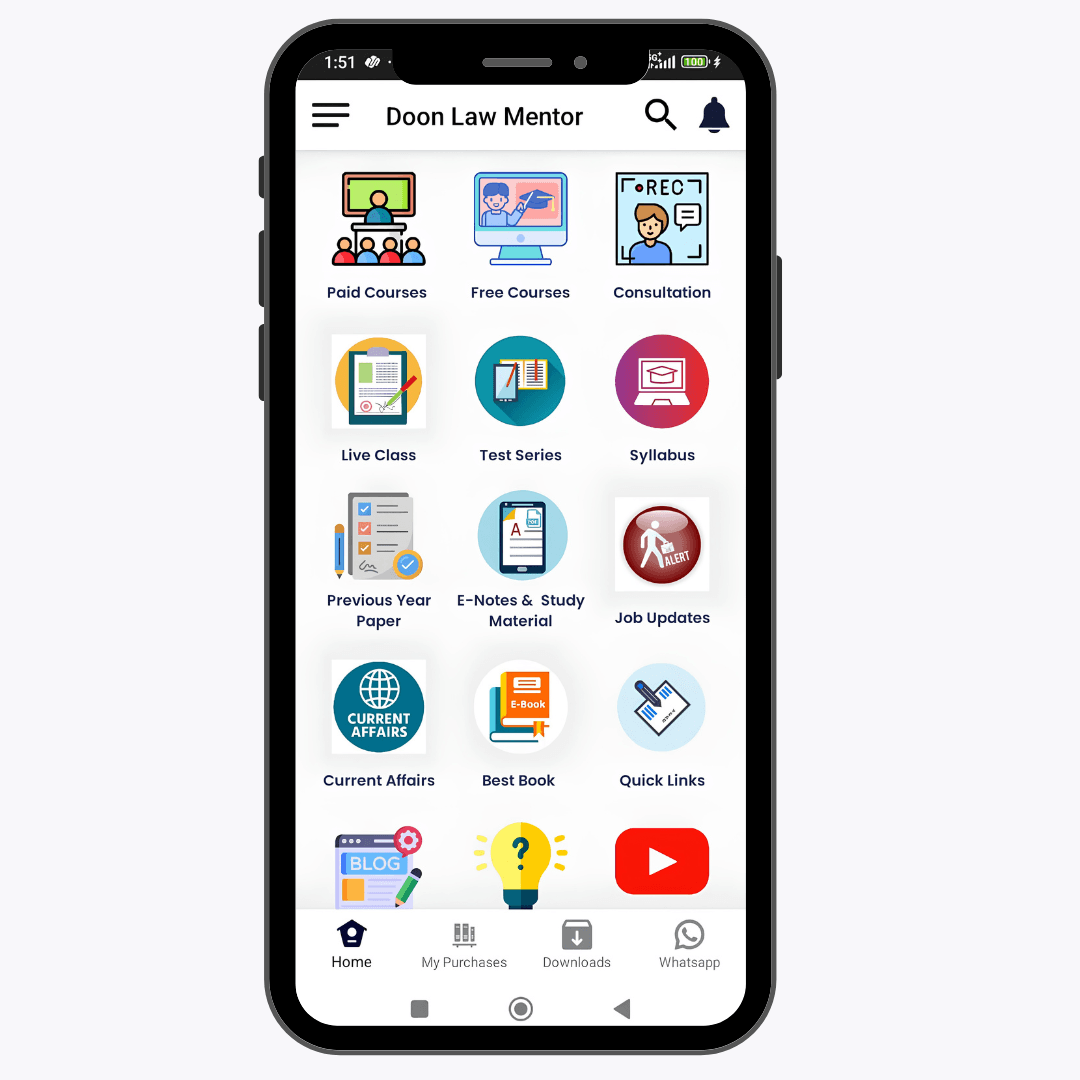
Get an app-exclusive discount, free AP Judiciary resources, classes, notes, tests and important preparation updates — all in one place.
| Notification Release Date | 25.09.2026 |
| Online Application Start Date | 01.10.2026 |
| Last Date to Apply Online | 26.10.2026 · 11:59 PM |
| Screening Test Date | To be notified |
| Hall Tickets | Before one week of Screening Test |
| Question Paper + Preliminary Key / Response Sheet | Within one week from Screening Test |
Use Notification No.118/2026-RC as the controlling source for Direct Recruitment and Recruitment by Transfer. The 2026 notification contains a specific transitional Law Degree position for Direct Recruitment.
The notification states that all Law graduates who have obtained Law Degree preceding one year as on the date of Notification are eligible to appear for the Civil Judge (Junior Division) notification issued for the year 2026.
This position is expressly linked in the notification to Bhumika Trust v. Union of India, W.P.(C) No.1110/2025, judgment dated 21.08.2026, pending amendment of the Andhra Pradesh State Judicial (Service and Cadre) Rules, 2026.
Applicants must possess a Law Degree awarded by a University established by law in India and must be a confirmed member or approved probationer in an eligible notified category.
Notification No.118/2026-RC prescribes Screening Test, Written Examination and Viva-Voce. Training and structured Law Clerkship follow selection.
Computer Based Test · 100 objective MCQs · 100 marks · 2 hours.
Paper I Civil Laws · Paper II Criminal Laws · Paper III Translation & Legal Essay.
50 marks · approximately 1:3 call ratio, subject to the notified tie rule.
Post-selection stage: one year of Judicial Academy training followed by one further year of structured Law Clerkship, subject to evaluation.
Get the free AP Civil Judge Judiciary Preparation eBook and follow a clear Prelims-to-Viva preparation roadmap.
The official selection scheme begins with one Computer Based Screening Test for shortlisting candidates to the Written Examination.
| Particular | Official Pattern |
|---|---|
| Mode | Computer Based Test |
| Questions | 100 objective multiple-choice questions |
| Marks | 100 |
| Duration | 2 hours |
| Shortlisting threshold | 40% and above for shortlisting consideration |
| Approx. ratio | 1:10 against available vacancies |
| Cut-off ties | Candidates securing identical marks at the cut-off are also called for the Written Examination |
| Merit treatment | Screening marks are not added to Written Examination marks and are not counted for final selection |
| Negative marking | Not specified in Notification No.118/2026-RC; follow any later APHC clarification |
Official Source — High Court of Andhra Pradesh · Notification No.118/2026-RC ↗
Build accuracy, statutory recall and time discipline around the officially notified Civil Laws and Criminal Laws syllabus.
The official notification lists Civil Laws and Criminal Laws for the Screening Test and Written Examination. Paper III separately tests Translation and Legal Essay.
The official syllabus expressly lists IPC, CrPC and the Indian Evidence Act and also BNS, BNSS and BSA. Prepare according to the syllabus as notified unless APHC subsequently issues a clarification or corrigendum.
The official Civil Laws syllabus applies to the Screening Test and Written Examination. Prepare the notified Acts, Rules of Practice and the legacy/new evidence-law combination exactly as listed.
Move from CPC and core private law to court practice, registration / stamp, A.P. Land Encroachment and evidence law. Keep a separate comparison sheet for the Indian Evidence Act and BSA because both are listed in the 2026 syllabus.
View Official Civil Laws Syllabus →Use the following topic-wise coverage as a preparation checklist while studying the notified Civil Laws syllabus.
The official 2026 syllabus combines legacy criminal laws, the new criminal codes, special criminal statutes, Criminal Rules of Practice and Andhra Pradesh-specific penal laws.
Prepare core codes first, then special criminal statutes, Criminal Rules of Practice and Andhra Pradesh-specific laws. Keep old-code to new-code comparisons in a separate revision sheet.
Old + New Criminal Laws Preparation →Use these accordions as a subject-wise preparation checklist under the official AP Civil Judge 2026 syllabus.
The notification is the controlling source for the 2026 syllabus. Any later APHC corrigendum or clarification prevails.
The Written Examination consists of 3 papers. Each paper carries 100 marks and is of 3 hours. Paper III is separately structured as Translation and Legal Essay and is qualifying only.
| Paper | Official Structure |
|---|---|
| Paper I | Civil Laws · 100 marks · 3 hours |
| Paper II | Criminal Laws · 100 marks · 3 hours |
| Paper III | English — Translation & Legal Essay Writing · 100 marks · 3 hours |
| Paper III · Part I | Translation · 40 marks |
| Paper III · Part II | Legal Essay · 60 marks |
| Answer Language | English, except the translation exercise |
The Screening Test rewards objective statutory accuracy. The Written Examination tests legal expression, issue identification, correct provisions, application, reasoning and concise conclusions.
Civil Laws · 100 marks · 3 hours
Criminal Laws · 100 marks · 3 hours
English ↔ Telugu Translation · 40 marks
Legal Essay · 60 marks
English except the translation exercise.
Paper III is qualifying only.
The notification prescribes category-wise Written Examination thresholds for Viva eligibility, a separate qualifying rule for both parts of Paper III, category-wise final aggregate requirements and a post-selection training / Law Clerkship structure.
Paper I ≥55% · Paper II ≥55% · Paper I + II aggregate ≥60%.
Paper I ≥50% · Paper II ≥50% · Paper I + II aggregate ≥55%.
Paper I ≥45% · Paper II ≥45% · Paper I + II aggregate ≥50%.
Paper I ≥55% · Paper II ≥55% · Paper I + II aggregate ≥60%.
Minimum 40% in Part I and minimum 40% in Part II · qualifying only.
Final aggregate uses Paper I + Paper II + Viva, followed by one-year training and one-year structured Law Clerkship.
Prepare the three new criminal laws directly from the Bare Acts, with provision-level accuracy for Prelims and structured application for Mains.
Offences, punishments, general principles, general exceptions and provision-based MCQs.
Investigation, arrest, bail, charge, trial, procedural timelines and criminal court powers.
Relevancy, admissions, confessions, documentary and electronic evidence, burden of proof and witnesses.
Official statutory texts: Act names above link directly to India Code, Government of India.
Andhra Pradesh-specific statutory and administrative material deserves a separate revision track. These areas should not be mixed casually with the general civil-law syllabus.
Paper III is highly improvable if you practise Translation and Legal Essay every week instead of postponing them to the final month.
Legal vocabulary · meaning preservation · grammar · statutory expressions · timed practice
Accurate legal English · terminology · syntax · clarity · timed practice
Legal and constitutional themes · rule of law · judicial reforms · access to justice · analytical writing
Use verified High Court of Andhra Pradesh question-paper and recruitment-archive sources, then map each paper to the current 2026 syllabus.
Use verified papers for stage-wise analysis, subject mapping, repeat-topic tracking, old-code to BNS/BNSS/BSA comparison and Written / Paper III practice.
Use the AP Civil Judge PYQ Analysis Framework →| Year / Use | Stage | Resource | Official / Study Link |
|---|---|---|---|
| 2025 | Screening | Official Question Paper | View Official PDF |
| 2025 | Recruitment | Civil Judge Archive | Open APHC Archive |
| 2024 | Recruitment | Official Recruitment Archive | Open APHC Archive |
| 2026 | Syllabus Map | Compare PYQs with Current Syllabus | Open 2026 Notification |
| Method | Screening | Act + Section Mapping | Map Civil-Law Questions |
| Method | Screening | Criminal-Law Mapping | Map Criminal-Law Questions |
| Method | Written | Issue + Provision + Application | Use Written Strategy |
| Method | Paper III | Translation + Legal Essay Practice | Use Paper III Strategy |
| Revision | All Stages | Repeat Topics + Error Notebook | Build Revision Cycle |
Use these sessions for Bare Act strategy, new criminal laws, answer writing and AP Civil Judge preparation planning.
Build a statutory comparison method useful for the AP syllabus, which expressly lists old and new criminal laws together.
Use the official DLM channels for current AP notification, syllabus and preparation updates.
Focus on issue identification, statutory provisions, legal reasoning, application and concise conclusions.
Revise local statutes, court rules, Telugu ↔ English Translation and Legal Essay as integral parts of the AP Civil Judge plan.

Known for simplifying complex Bare Acts, new criminal laws and examination concepts for Screening, Written and Interview preparation.
Use the long-form sessions on our two channels for Bare Act clarity, current legal updates and Judiciary/APO preparation.
Doon Law Mentor students have used our courses, Bare Act-focused teaching, test practice, answer-writing support and personalised mentoring across Judiciary, APO and other competitive law examinations.
Hear directly from Srishti Baniyal about her Judiciary preparation journey, interview strategy and experience with Doon Law Mentor.
Published DLM success stories from Judiciary and APO examinations.
UKPCSJ · Rank 2
Uttarakhand Judicial Services
“The comprehensive lectures, study material, expert guidance and mock-interview preparation helped me strengthen my Judiciary preparation.”
Judiciary · Rank 11
Judicial Services Selection
“The personalised guidance and detailed subject coverage helped me prepare with greater confidence.”
UKAPO · Rank 27
Selected as Assistant Prosecution Officer
“Ashish Jain Sir’s guidance, preparation support and mentoring gave me greater direction and confidence for the APO examination.”
Students discuss preparation strategy, Bare Act focus, mock practice, interview readiness and the role of structured mentoring during their examination journey.
Published student feedback also consistently highlights concept clarity, detailed teaching, practical examples, doubt support and the DLM mobile learning experience.
Simran Bhaskar
Judiciary Aspirant
“The Judiciary sessions are detailed and full of practical examples. The case-law-based study material and mentorship have been very helpful for my preparation.”
DLM Student ReviewIshan Mathur
Judiciary Student
“My experience with Doon Law Mentor has been very knowledgeable. The classes have improved my conceptual clarity, and I receive consistent support whenever I need help with doubts.”
DLM Academy ReviewChoose complete preparation, recorded preparation or browse the current AP Judiciary course catalogue.

Integrated preparation for Screening, Written Examination and Viva with AP-specific laws.

Flexible recorded preparation for the complete notified syllabus.

Explore current complete, recorded, subject-wise and revision resources for AP Civil Judge preparation.
Exam-focused support without replacing the official notification or statutory text.
Preparation built around judicial-service exam demands.
Civil, criminal, practice rules and AP-specific statutes.
Both statutory sets appearing in the official syllabus are tracked.
MCQ accuracy and descriptive answer writing are integrated.
Paper III receives separate skill practice.
PYQ-based revision, error analysis and timed practice.
Reading gives knowledge. Testing reveals selection readiness.
See how much of your present study can actually be converted into exam-ready answers.
Measure how consistently you can answer correctly under exam conditions.
Learn when to solve, skip and return without losing valuable examination time.
Identify subjects and provisions that need deeper conceptual or Bare Act revision.
Convert every test into a targeted revision list instead of revising everything again.
Build decision-making discipline for pressure, accuracy and time-bound attempts.
Begin with verified APHC previous-year papers and timed self-assessment. Use the current DLM Academy catalogue for any additional AP practice resources that are actually available.
The Viva-Voce evaluates legal clarity, personality, judgment, communication and overall suitability for judicial office.
| Viva-Voce | 50 marks |
|---|---|
| Call Ratio | Approximately 1:3, subject to tie rule |
| Absence | Absent candidate deemed disqualified |
| Final Merit | Paper I + II + Viva |
Until dedicated AP child pages are created, these cards use real deep anchors within this hub rather than fabricated URLs.
Direct, transfer, age, fee and document conditions.
Open section →PYQsVerified APHC archive entries and PYQ-use method.
Open PYQs →Screening100-question CBT pattern and shortlisting rules.
Open Screening →WrittenPaper I, Paper II and answer-writing framework.
Open Written →CivilOfficial civil syllabus and important topic map.
Open Civil Laws →CriminalLegacy + new criminal-law syllabus coverage.
Open Criminal Laws →AP-specificRules of Practice and AP special statutes.
Open AP Laws →Paper IIIEnglish↔Telugu translation and legal essay strategy.
Open Paper III →Viva50-mark interview and judicial-suitability preparation.
Open Viva →Start with the official roadmap, use verified PYQs to assess yourself, and choose structured guidance only when it matches the support you need.
Start with free resources first. Choose paid preparation only when it matches the support you need.

Use the Doon Law Mentor app for free learning resources and your enrolled classes, notes, tests and updates.
Notification No.118/2026-RC dated 25.09.2026 is the primary source. Any later APHC corrigendum or clarification prevails. Doon Law Mentor is an independent educational platform.